
Cogneez makes learning easy and fun!
3 July 2026
Know someone writing? Share it.
Cogneez makes learning easy and fun — and here is how. Open the app and there is no more staring at a wall of chapters wondering where to begin. The new dashboard does one job: it tells you what to do right now.
- "What must I learn now?" — answered the moment you open it: today's due reviews, your weak spots, and your honest pace to exam day, all on one screen.
- Or just jump straight in — one tap into a recall session, a chapter, or a timed mock. No hunting, no deciding.
That is the fresh new home. But the look is the smallest part of the story: underneath it runs a study system built, deliberately, on the handful of learning techniques that decades of research say genuinely work — the ones that feel like effort while you do them and quietly pay you back in the exam hall months later.
In this post:
- Your new home, part by part — every card on the dashboard, and what it is for
- Why it actually works: the science — spaced repetition, retrieval practice, interleaving, calibration, self-explanation
- One recall session, start to finish
- Insights: your learning, made visible
- Your journey
- The bigger picture: Mindscape
- Never lose your place: Home and the reading bar
- What is coming next — Jeeni your AI tutor, plus OSCE and OSPE prep
Grab a coffee. Here we go.
Part 1 — Your new home, part by part
Everything you need sits on one page, in the order you actually use it.
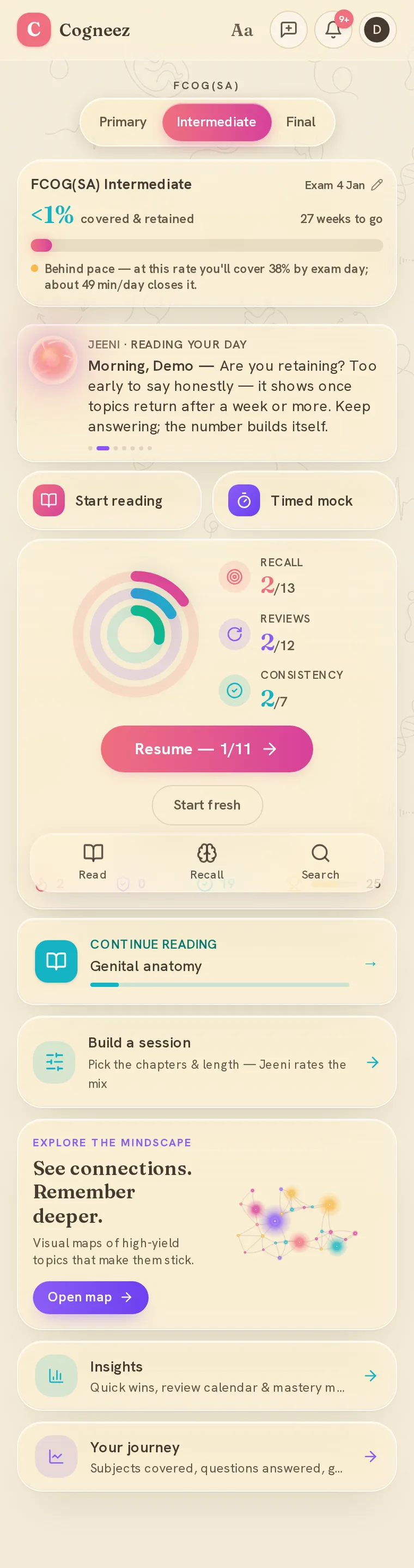
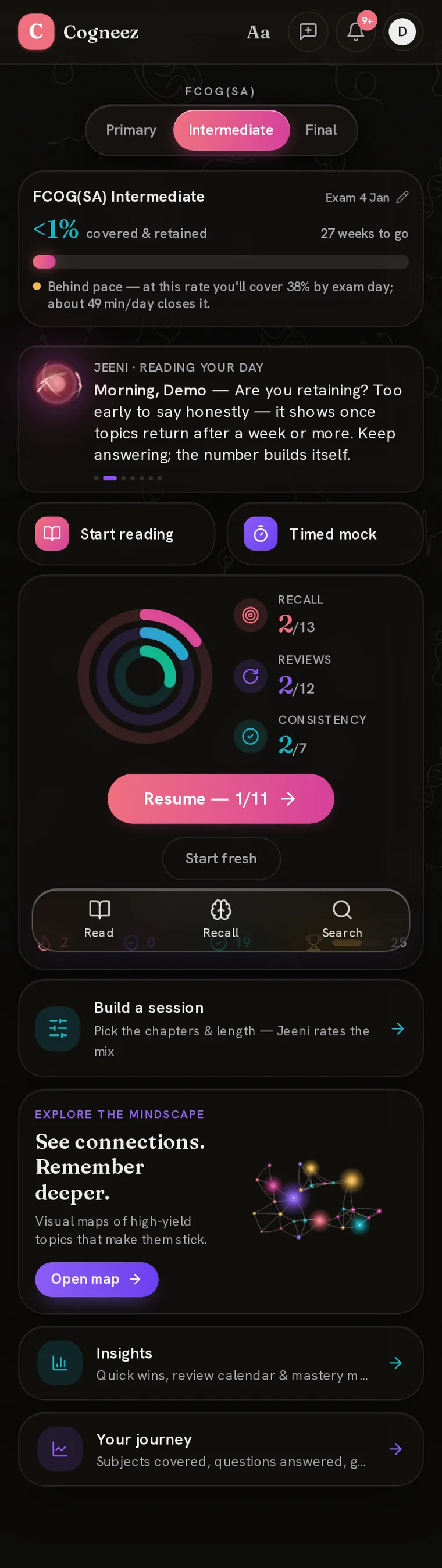
The top bar and your course switch. Your three FCOG(SA) courses — Primary, Intermediate, Final — live at the top. Tap to switch; everything below reflects the course you are in. On the right sit your reading settings (Aa), feedback, notifications and your account.
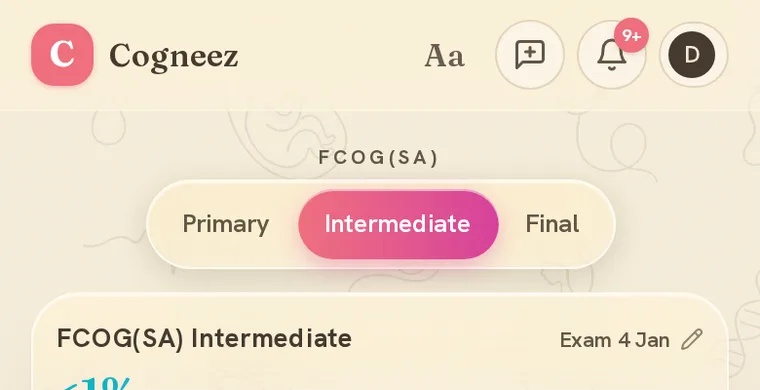
Your readiness bar. Set your exam date and this becomes an honest, paced countdown: how much of the syllabus you have covered and retained, how many weeks remain, and whether your current pace gets you there. It tells you the truth — "on track", or "behind pace, and here are the daily minutes that fix it" — never empty cheerleading.
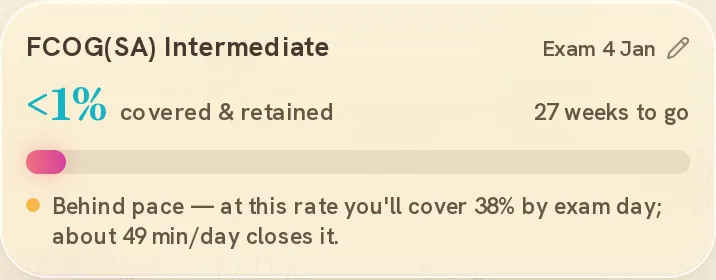
Jeeni's daily brief. A short, personal read of your day in plain language — what to focus on, an honest note on whether things are sticking yet, and a small win to carry. She greets you by name and speaks to your actual data, not a generic template.
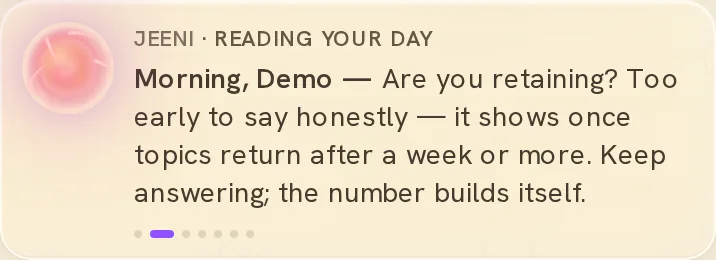
Quick actions. Straight into reading, or into a timed mock, in a single tap.

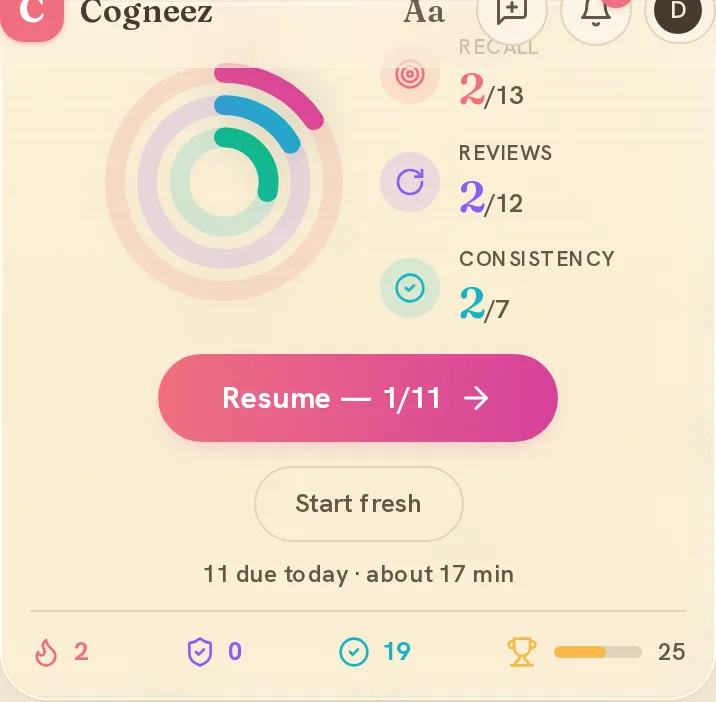
Your three rings. One glance tells you the whole day: Recall (questions answered toward your daily goal), Reviews (due reviews cleared), and Consistency (days studied this week). The button under them is your session — start today's recall, or resume one already in progress.
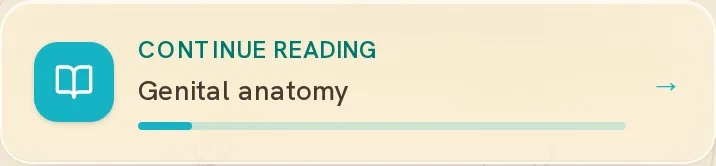
Continue reading. Left a chapter part-read? It waits right here with a progress bar — one tap back to exactly where you stopped.
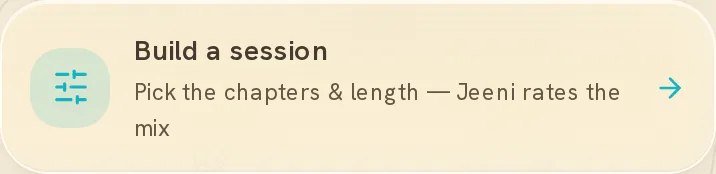
Build a session. When you want to steer, pick the exact chapters and length yourself, and Jeeni rates the mix before you start.
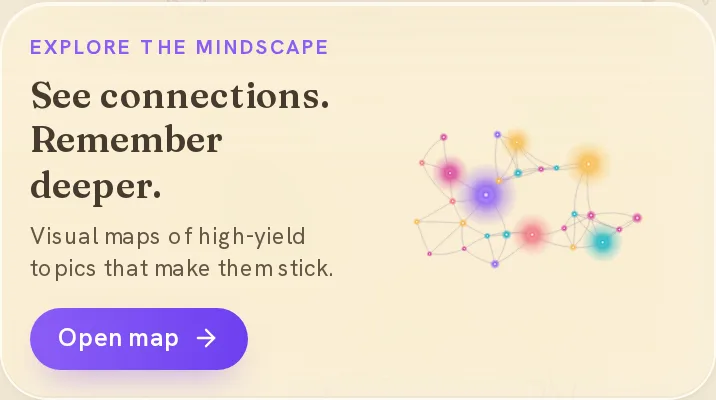
Explore the Mindscape. A doorway to the concept map — the big-picture view of how everything connects (a whole section on it below).
Insights and Your journey. Two ways to look back at your learning — the analytics hub and a coverage-and-history view, both explained further down.

And because how a screen feels matters when you are tired, the whole thing works in a calm light (sepia) theme or a deep dark one — your call, in the Aa menu.
Part 2 — Why it actually works: the science
Here is the uncomfortable truth about studying: feeling like you have learned something and actually being able to recall it under pressure, months later, are two different things. Re-reading and highlighting feel productive, but the evidence is blunt — they barely move long-term recall. A different, smaller set of methods does. Cogneez is built on them, so you get them without having to design your own system. Here is each one, and where it lives.
Spaced repetition — the right review, at the right time
Everything you learn fades on a predictable curve. The most reliable way to beat that curve is to space your reviews — revisit a fact just as you are about to forget it, and each review flattens the curve a little more. Five reviews crammed into one evening keep almost nothing; the same five spread over two weeks stick for months.
Tracking that by hand across a whole syllabus is impossible, so Cogneez runs a modern spaced-repetition scheduler called FSRS (the Free Spaced Repetition Scheduler) quietly in the background. Every answer updates its estimate of how well a concept is holding and schedules the next review for the moment it will do the most good. You just see what is due today, in your Reviews ring.
Why it matters for exams: the FCOG papers test the whole syllabus at once, long after you first read each topic. Cramming cannot hold that much for that long. Spaced review is the only study pattern that reliably survives to exam day — the difference between recognising an answer and retrieving it.
Retrieval practice — and how our questions are built
Testing is not just measurement. The act of pulling an answer out of your own head is itself one of the most powerful ways to cement it — the testing effect. So the core loop of Cogneez is answering single-best-answer questions (SBAs), then reading the explanation.
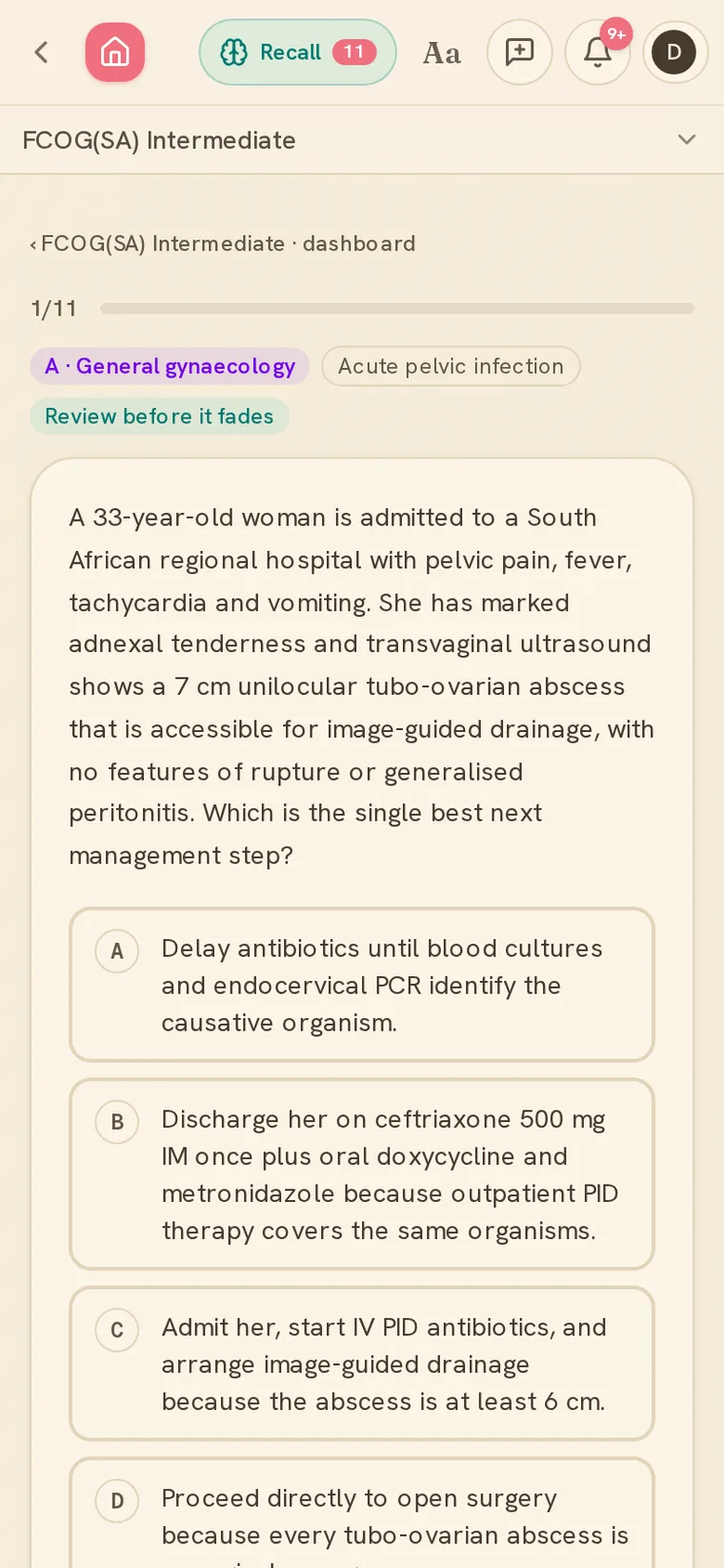
The questions are written to make retrieval work, not to trick you. Every SBA is designed so that:
- the stem is answerable before you look at the options — you commit to a line of reasoning first;
- the options force a genuine single best decision, where several are partly right and one is most correct;
- every distractor is a plausible mistake — a common misconception, an outdated shortcut, the right idea in the wrong setting — never an obvious throwaway;
- and every option is explained, so a wrong answer teaches you exactly why your choice was tempting and why the key is better.
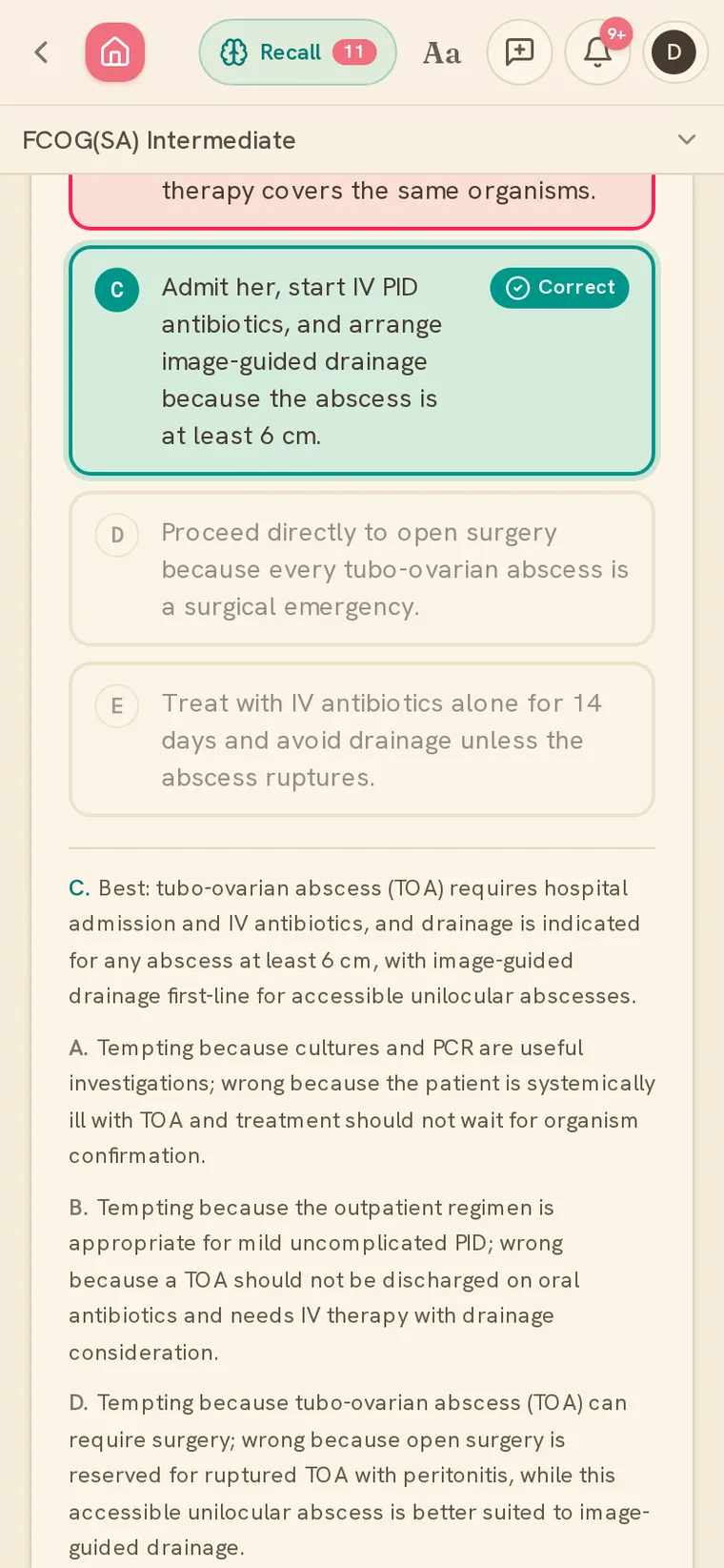
That explanation panel is where most of the learning happens. It turns one question into a small, complete lesson.
Interleaving — deliberately mixing topics
Left to instinct, we study in blocks: all of one topic, then the next. It feels smooth and produces a comforting fluency — but that fluency is largely an illusion that evaporates by exam day. Interleaving — shuffling different topics together — feels harder, yet consistently produces better retention and, crucially, better ability to tell similar things apart. That last part is the whole game in O&G, where the skill is discriminating between conditions that look alike. A Cogneez session interleaves on purpose, and the little tags under the progress bar tell you why each question surfaced ("Review before it fades", "Fix a weak spot", "Tell apart look-alikes") — the method working out loud.
Judge your confidence — calibration
Knowing what you know is a separate skill from knowing the material, and a confident wrong answer is the dangerous one — in exams and on the ward. So before each answer is revealed, Cogneez asks how sure you are.
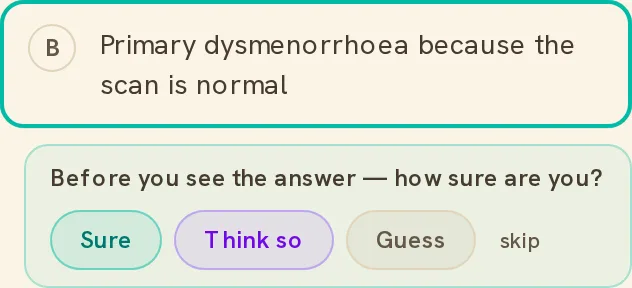
Tap Sure, Think so or Guess. It makes you pause and commit — a tiny retrieval in itself — and it surfaces the highest-value pattern in all of learning: the confident mistake. A topic you were sure about and got wrong is the single best thing to fix, because you did not know you were exposed. Your insights flag exactly these.
Explain it in your own words — elaboration
Reading an explanation is passive. Generating one — saying, in your own words, why the answer is what it is — is active, and the evidence on self-explanation is strong. On the answers where it matters most, Cogneez holds the explanation behind a brief beat of your own reasoning.
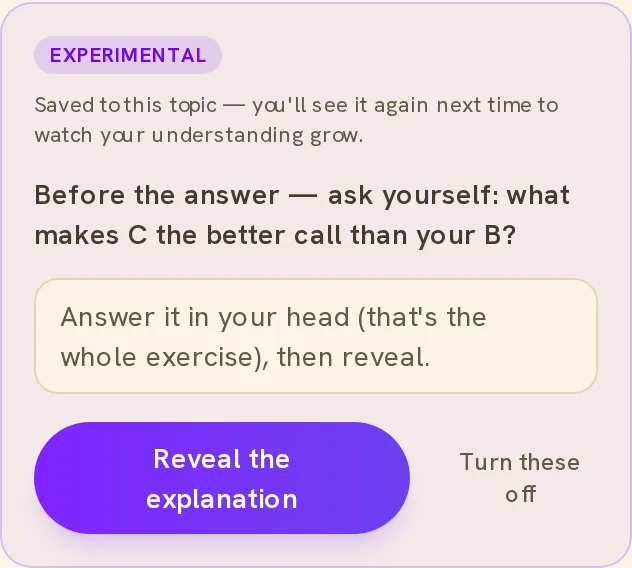
A few honest details: this is dosed — it appears only where reasoning pays off (a confident miss, a weak spot), never on every question, because the point is momentum, not friction. What you write is saved to that topic, so next time it comes up you can see what you said before and watch your understanding grow. It carries a built-in was this helpful? rating, is clearly marked experimental, and you can switch it off with one tap — every explanation then reveals instantly, with a quiet one-line switch to turn it back on whenever you like.
A gentle on-ramp for brand-new topics
One subtlety: retrieval is powerful, but you cannot retrieve something you have never met. For a concept you are seeing for the very first time, Cogneez offers a one-tap way to orient yourself in the section first — or to take a reasoned guess and learn from the explanation. Optional, never blocking, and gone the moment you have seen a topic once.
Part 3 — One recall session, start to finish
A recall session is where all of this comes together. Start it from the big button on your home, or the Recall tab. It serves a mix — reviews that are due, weak spots to repair, look-alikes to tell apart, and new ground — question by question, with the explanation after each.
The best part: it waits for you. Studying happens in the gaps of a clinical day, so a session is fully resumable. Get pulled away mid-question, close the app, come back tomorrow — you land back on the exact question you left, even halfway through an explanation. Nothing resets.
When you want calibration instead of coaching, a timed mock puts you in the exam seat — a mixed paper, on the clock, with feedback held to the end, just like the real sitting.
Part 4 — Insights: your learning, made visible
The insights page answers the questions that keep you up at night — am I covering enough? is any of it sticking? where should I start? — in plain charts.
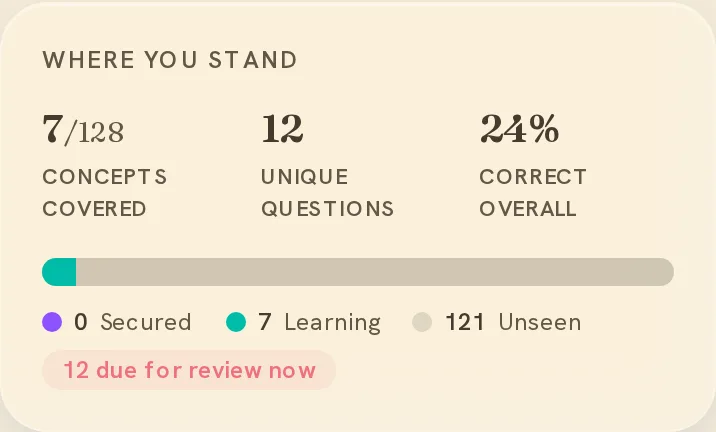
Where you stand. Three honest numbers — concepts covered, unique questions answered, overall correct rate — and the one that matters most: a memory pipeline showing how many concepts are Secured (reliably retrievable), still Learning, or Unseen, plus how many are due for review right now.
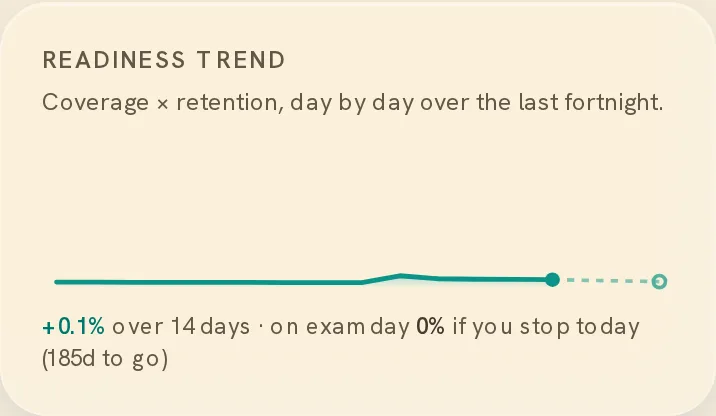
Is it sticking? The honest test. A readiness trend shows coverage-times-retention day by day, and a delayed recall figure shows how often a topic is still correct when it comes back after a real gap — the truest measure of durable memory, not short-term familiarity.
Mastery map. Every domain, sorted by how many marks it carries in the exam, so you always know where effort converts to the most marks. A weak, heavily-weighted domain rises to the top.
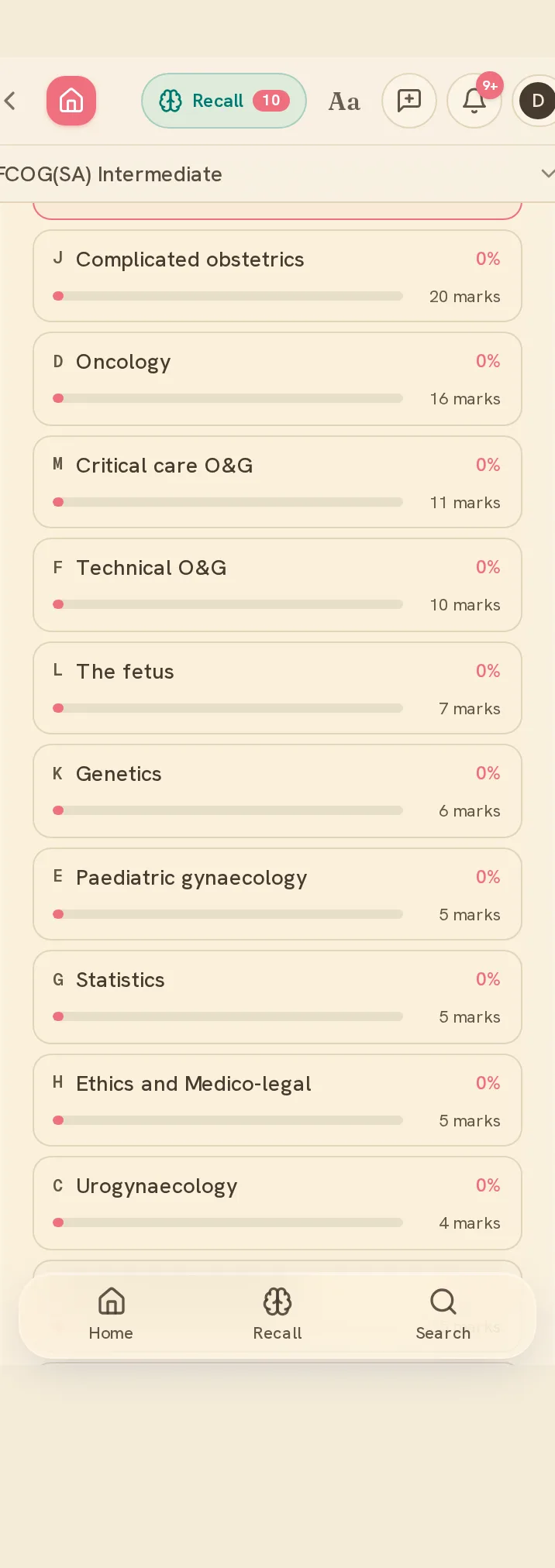
It reads just as clearly in dark mode:
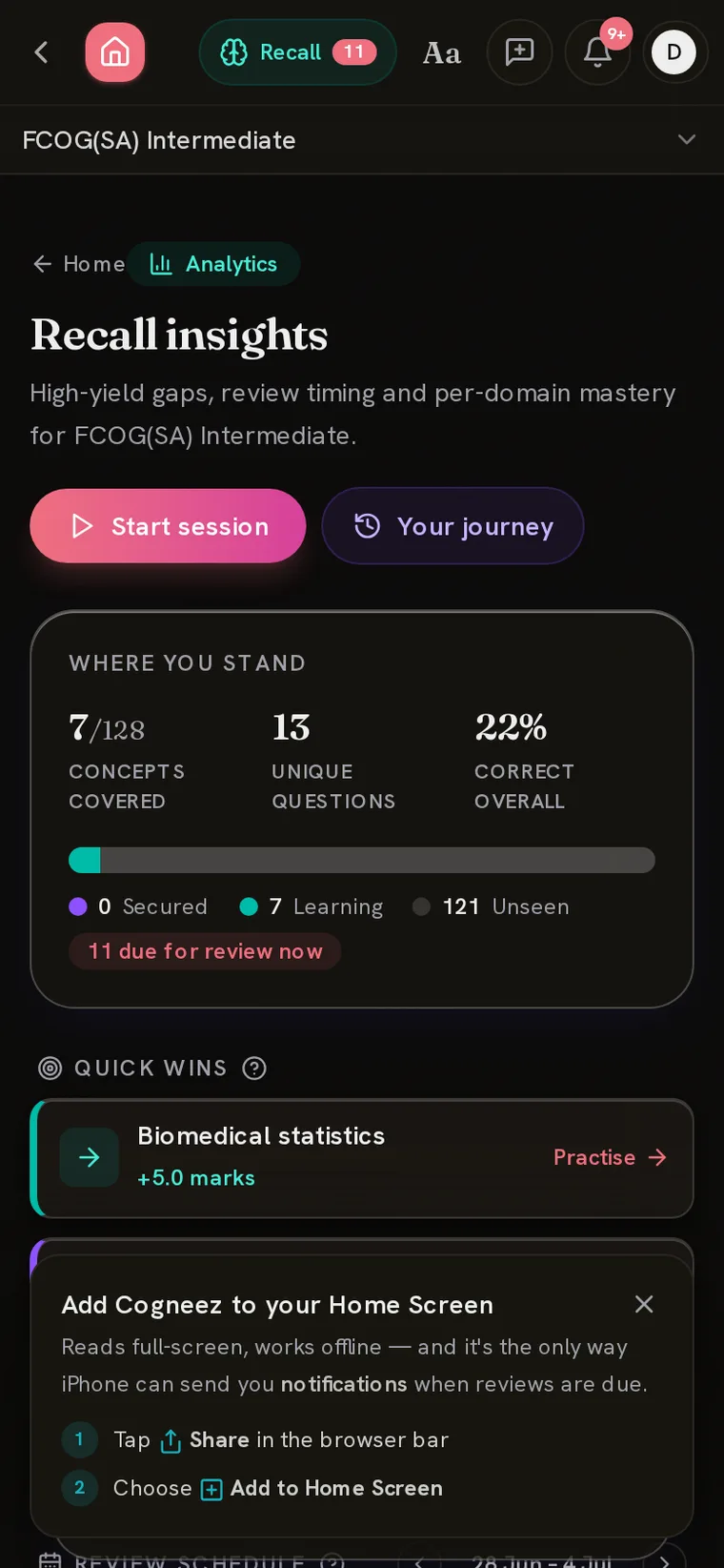
How to use it: start each week here. Look at is it sticking first, then the mastery map for a high-marks, low-mastery domain, then let a recall session do the rest. Ten seconds, and you know exactly where to point your day.
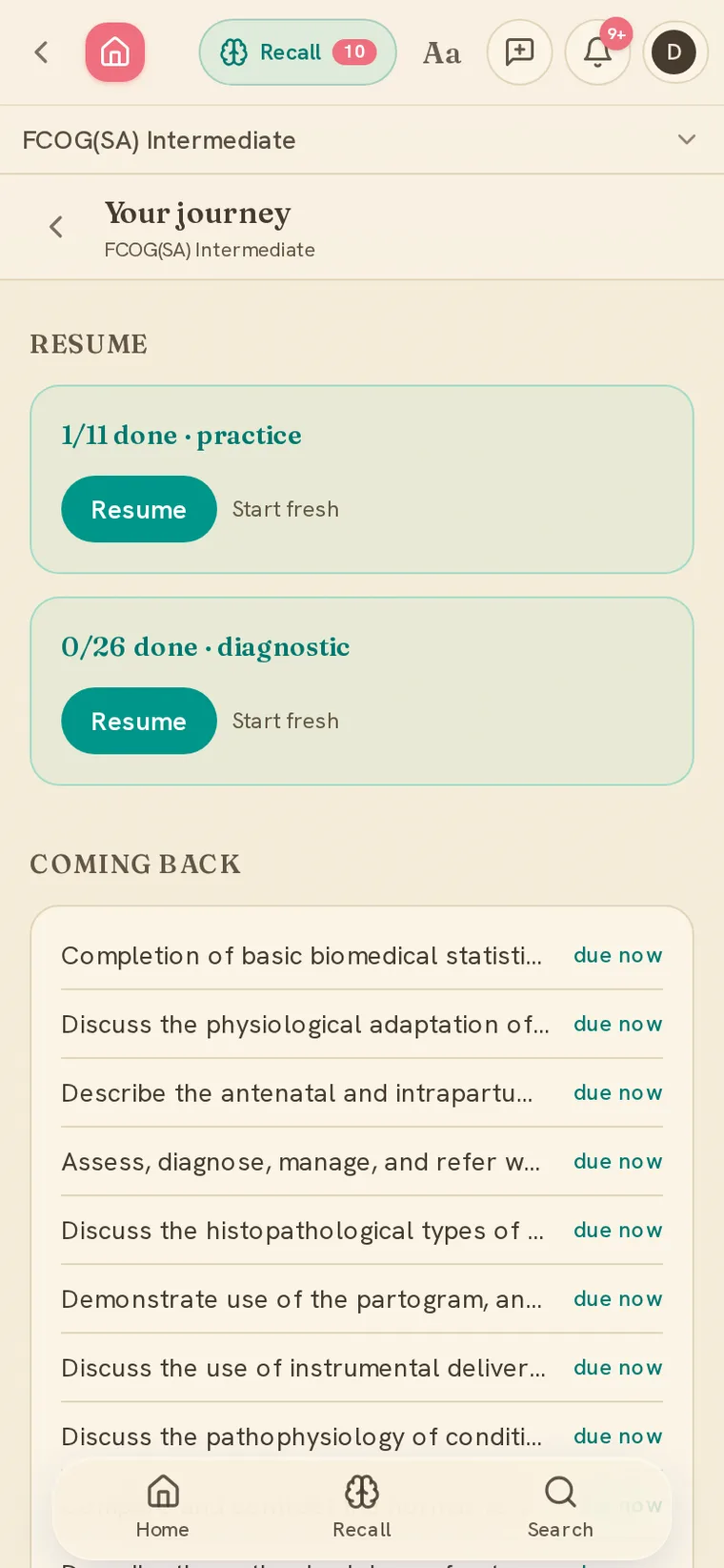
Part 5 — Your journey
The longer view — what you have covered, what you have neglected, and every session you can pick back up.
Part 6 — The bigger picture: Mindscape
Retrieval and spacing make individual facts stick. But exams — and clinical shifts — reward something more: seeing how everything connects. Experts do not store medicine as a list of isolated facts; they hold it as a web of linked ideas and compact "illness scripts" that let them recognise a picture instantly. Building that web is a different kind of study — exploring relationships, not drilling items — and that is what Mindscape is for.
Mindscape is a living map of the concepts in your course, linked by meaning. Tap any concept and it moves to the centre, with its real clinical relationships fanning out around it — what causes it, what it is treated by, what it is complicated by, what raises the risk.
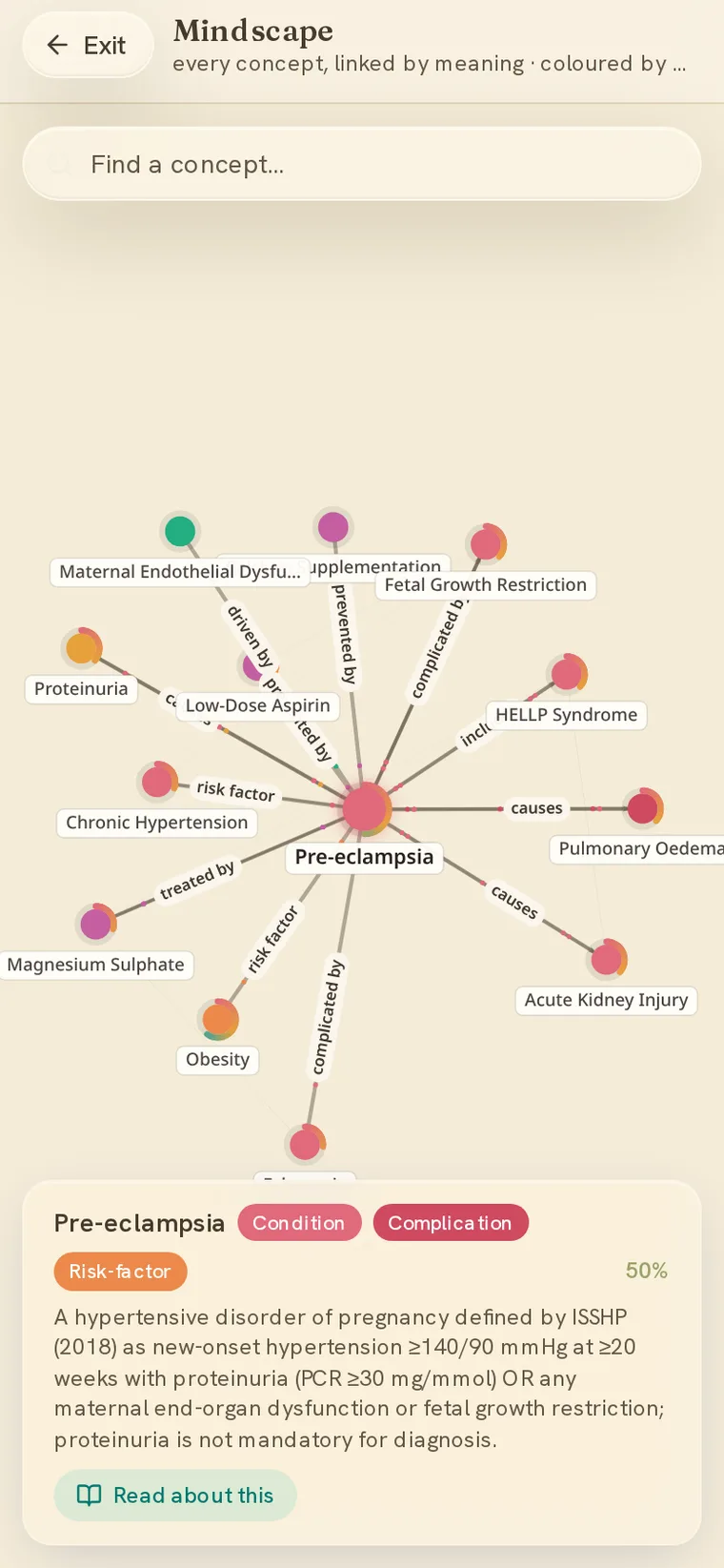
This is genuinely different from a search or a contents list. Standing on pre-eclampsia, you can see at a glance that it is driven by endothelial dysfunction, prevented by low-dose aspirin, treated by magnesium sulphate, and complicated by HELLP, eclampsia and fetal growth restriction — each one tap away, with a Read about this link straight into the chapters. You explore the way an examiner's mind moves: from a condition, out along its connections, and back.
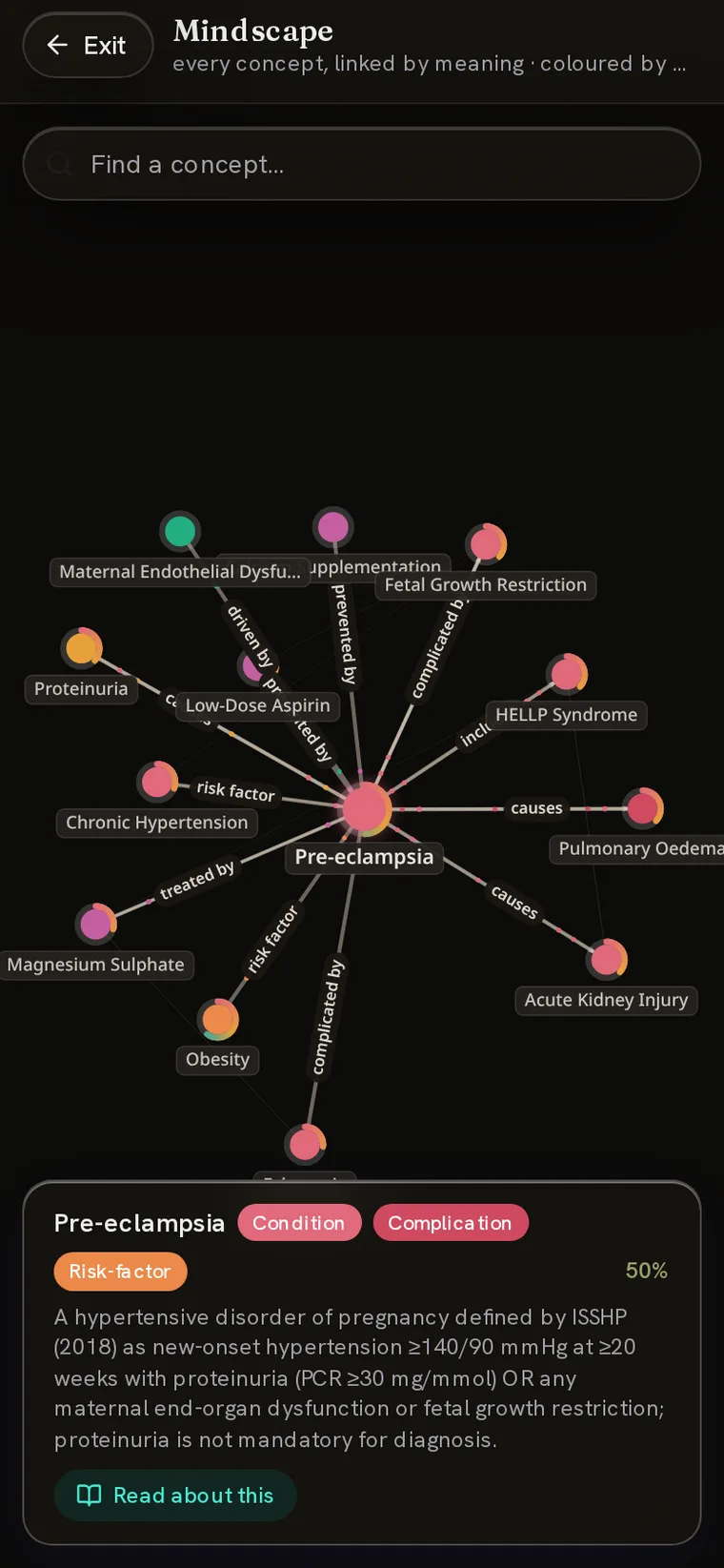
How to use it: when a topic feels like a pile of disconnected facts, open Mindscape and walk its neighbourhood for a few minutes. Follow the links, read where you are shaky, and let the shape of the map become the shape of your understanding. This is how loose facts compress into the fast, connected recall that exams and wards demand.
Part 7 — Never lose your place: Home and the reading bar
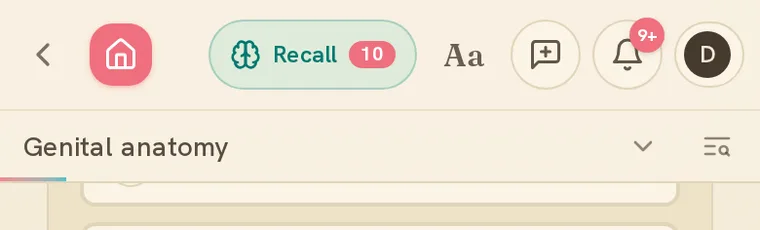
A small but important change: while you are reading a chapter, the Home button — the clear red house at the top left — takes you straight back to your dashboard. No hunting, no back-button guessing.
And at the bottom of every chapter sits a floating bar with everything you need while reading: Prev and Next to move between chapters, Contents to jump around, Recall to test yourself on what you just read, and Search.
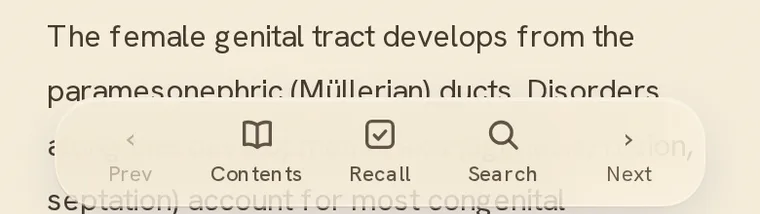
The pairing is deliberate: read a section, then tap Recall to immediately retrieve it. Reading followed by retrieval is far stronger than reading alone.
Where AI fits — today, and what is coming
We are careful with this word. Cogneez is not "an AI that studies for you", and the learning science above works with or without it. What our learning intelligence does today is personalise the system to you: it decides which concept to resurface and when, paces your plan to your exam date, notices your confident mistakes and weak domains, and keeps the concept map and content current and correct. The methods are the point; the intelligence is what makes them fit you.
And this is where it gets exciting. Here is what we are building next.
Jeeni, your AI tutor — in conversation. Right now Jeeni reads your data and briefs your day. Soon she will talk back: ask her why you keep slipping on a topic, have her walk you through a concept the way a patient consultant would, and let her build your run-in to the exam around your real weak spots. A tutor who has read everything, remembers every topic you have struggled with, and never sleeps.
OSCE and OSPE prep — with a live examiner. The written papers are only half the battle. We are building Jeeni into an OSCE and OSPE examiner: timed stations, staged cues just like the real circuit, and a graded debrief afterwards. Crucially, she will coach the thing candidates lose the most marks on — technique: how to structure an answer, how to say it out loud under pressure, when to lead and when to stop talking. Not just whether your medicine is right, but whether you present like someone who is ready to pass.
And more — richer audio, deeper concept maps, and content that keeps pace with the guidelines. Your feedback decides what we ship first, so tell us what would help you most.
The evidence
The techniques above are among the most robust findings in cognitive and educational psychology. Key sources:
- Dunlosky, J., Rawson, K. A., Marsh, E. J., Nathan, M. J., & Willingham, D. T. (2013). Improving Students' Learning With Effective Learning Techniques. Psychological Science in the Public Interest, 14(1), 4–58. — rates practice testing and distributed practice as the highest-utility techniques.
- Roediger, H. L., & Karpicke, J. D. (2006). Test-Enhanced Learning: Taking Memory Tests Improves Long-Term Retention. Psychological Science, 17(3), 249–255.
- Karpicke, J. D., & Blunt, J. R. (2011). Retrieval Practice Produces More Learning than Elaborative Studying with Concept Mapping. Science, 331(6018), 772–775.
- Cepeda, N. J., Pashler, H., Vul, E., Wixted, J. T., & Rohrer, D. (2006). Distributed Practice in Verbal Recall Tasks: A Review and Quantitative Synthesis. Psychological Bulletin, 132(3), 354–380.
- Rohrer, D., & Taylor, K. (2007). The shuffling of mathematics problems improves learning. Instructional Science, 35, 481–498. — interleaving.
- Bjork, R. A., & Bjork, E. L. (2011). Making things hard on yourself, but in a good way: Creating desirable difficulties to enhance learning. In Psychology and the Real World.
- Chi, M. T. H., de Leeuw, N., Chiu, M.-H., & LaVancher, C. (1994). Eliciting self-explanations improves understanding. Cognitive Science, 18(3), 439–477.
- Kornell, N., Hays, M. J., & Bjork, R. A. (2009). Unsuccessful retrieval attempts enhance subsequent learning. Journal of Experimental Psychology: Learning, Memory, and Cognition, 35(4), 989–998.
- Schmidt, H. G., & Rikers, R. M. J. P. (2007). How expertise develops in medicine: knowledge encapsulation and illness script formation. Medical Education, 41(12), 1133–1139.
- The FSRS spaced-repetition scheduler is open source: github.com/open-spaced-repetition.
None of this is exotic. It is simply the study system a well-informed tutor would build for you — assembled once, kept honest, and pointed at the exam you are actually sitting. Welcome to the new Cogneez.