
Enhanced study sessions: inside the new Recall Hub
5 July 2026
Know someone writing? Share it.
In the exam, you do not get to recognise the answer. You have to recall it — pulled cold from memory, under pressure, and trusted enough to act on. Recognising a fact on the page and producing it in the viva are different skills, and only one of them passes Finals.
That is what recall is for: not to test what you know, but to build it. Every time you pull a fact back out of your own head, the path gets a little deeper — quicker to find next time, and it holds for longer. Reading puts knowledge in; recall is what makes it stay.
And it just got sharper. Open a session today and it still gives you one best-answer question at a time — but now it asks how sure you are before you commit, holds the explanation for a beat so you actually have to think, and at the end Jeeni reads your paper back to you, concept by concept, naming the exact thing you got wrong and why the right answer is right.
None of this is decoration. Every piece is one of the handful of study techniques that decades of learning science say genuinely move the needle: the ones that feel like effort while you do them and quietly pay you back months later, in the exam hall.
The fastest way to understand it is to feel it. Start a recall session → — ten questions, five minutes. Then come back and read why each part is there.
In this post:
- The recall session — retrieval, not re-reading
- Before you peek: how sure are you?
- The reflection beat
- The answer — and what your confidence just told you
- In a hurry? Quick mode
- Jeeni reads your session, concept by concept
- The five ideas doing the work
- Jeeni: how to actually use this
The recall session — retrieval, not re-reading
Re-reading a chapter feels productive and mostly is not. The single most reliable way to move something into durable memory is to pull it back out — to be asked, and to answer from your own head before you see the options settle. That act of retrieval is the learning event, not the reading that came before it.
So a recall session is a stream of single-best-answer questions — one topic, then a deliberately different topic, then another. The stem is answerable before you look at the options; the options force a genuine decision between plausible neighbours, not a spot-the-odd-one-out.
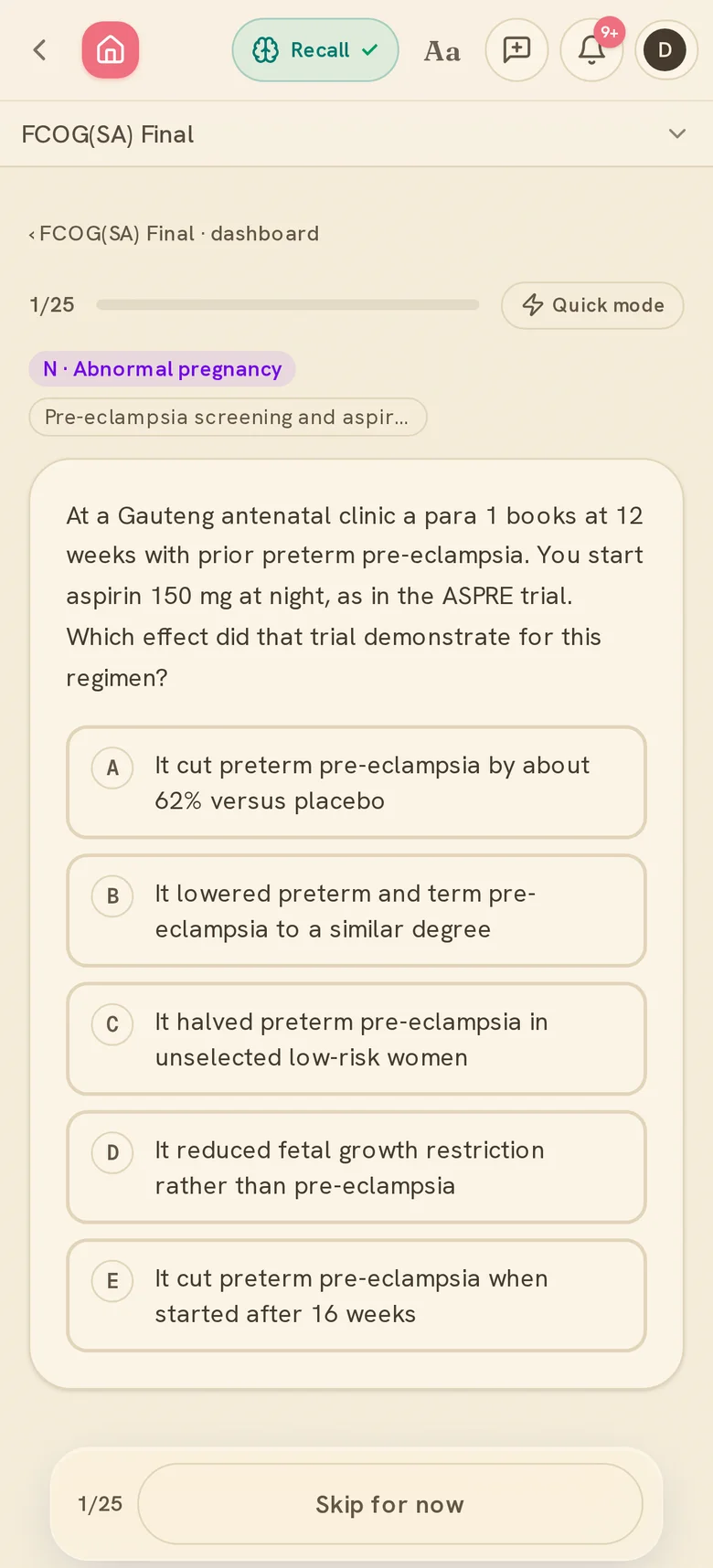
Every answer quietly updates your plan: miss something and it comes back sooner; nail it and it moves further away. You never manage a queue — you just answer, and the schedule takes care of itself.
Before you peek: how sure are you?
Here is the part that changes everything. The moment you pick an option, before the answer is revealed, Jeeni asks one small question: how sure are you — Sure, Think so, or Guess?
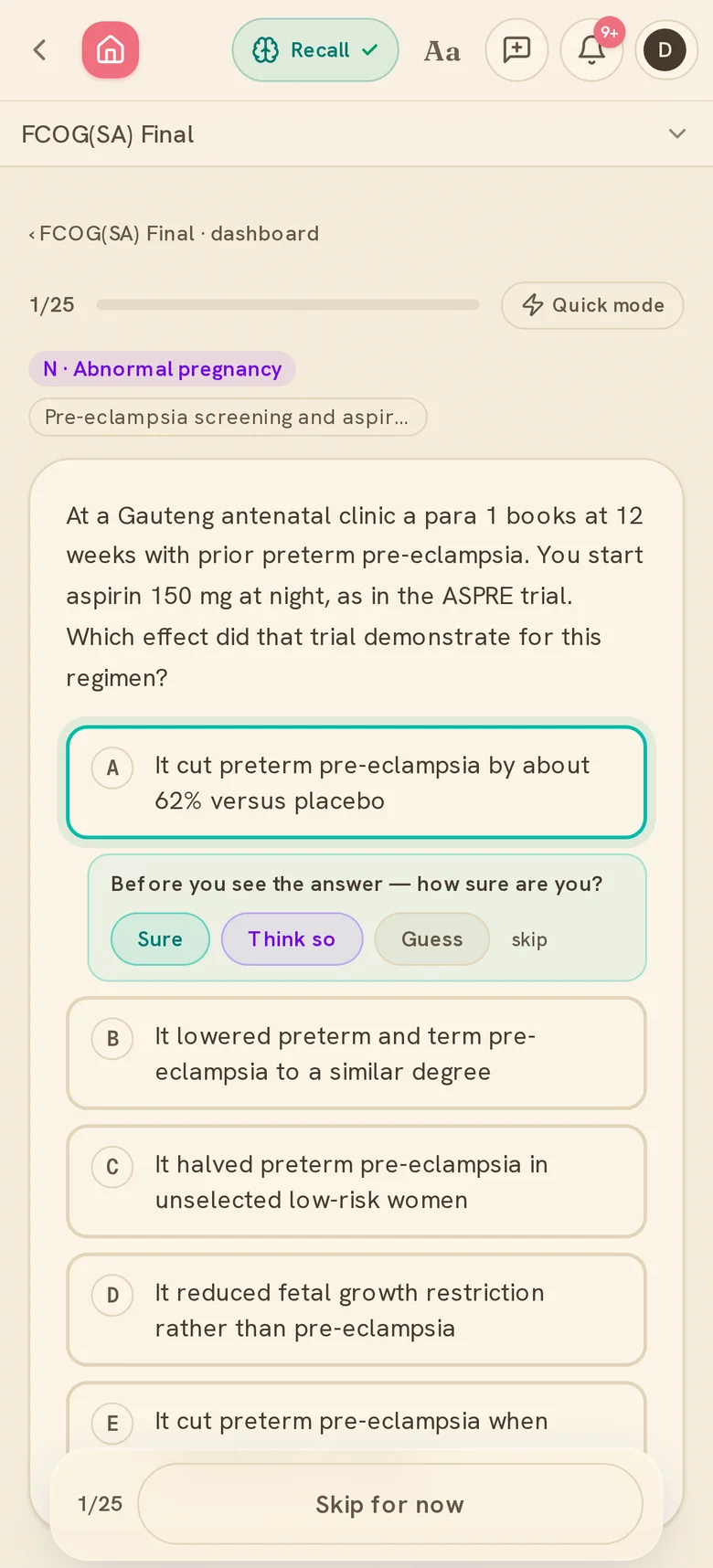
That one tap is calibration — the match between how confident you feel and how correct you actually are. It is a clinical skill in its own right (the registrar who knows they are unsure asks for help; the one who is confidently wrong does not), and it is trainable. The tap costs you a second and turns every question into two pieces of data instead of one: what you know, and whether you know that you know it.
The most valuable moment in any session is sure and wrong — the thing you were certain of and still missed. That is a hidden misconception surfacing, and once you fix it, it tends to stay fixed. Jeeni hunts for those on purpose.
The reflection beat
On a question you get wrong, the model explanation does not appear straight away. First, a short prompt: before the answer — what makes B the better call than your A?
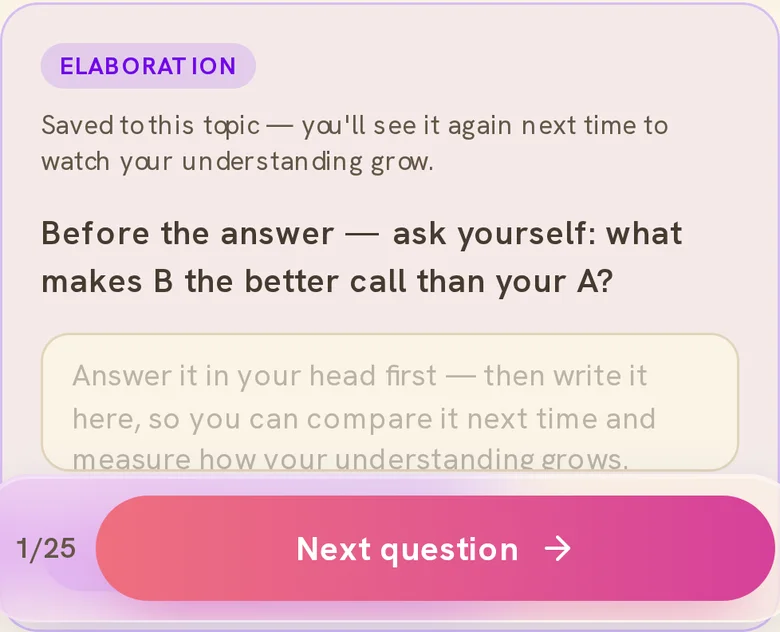
This is elaboration (self-explanation): a few seconds of generating your own reasoning, anchored to the specific choice you just made. Reaching for the answer yourself — even imperfectly — before you are told is what builds the connection that transfers to a new vignette in the exam. What you write is saved to that topic, so next time you can see your understanding grow. One tap reveals the explanation whenever you are ready; and if you would rather not, you can turn it off.
The answer — and what your confidence just told you
Now the explanation — every option explained, not just the right one, so you learn why each distractor is tempting and why it fails. And underneath, a line that reads your confidence back to you:
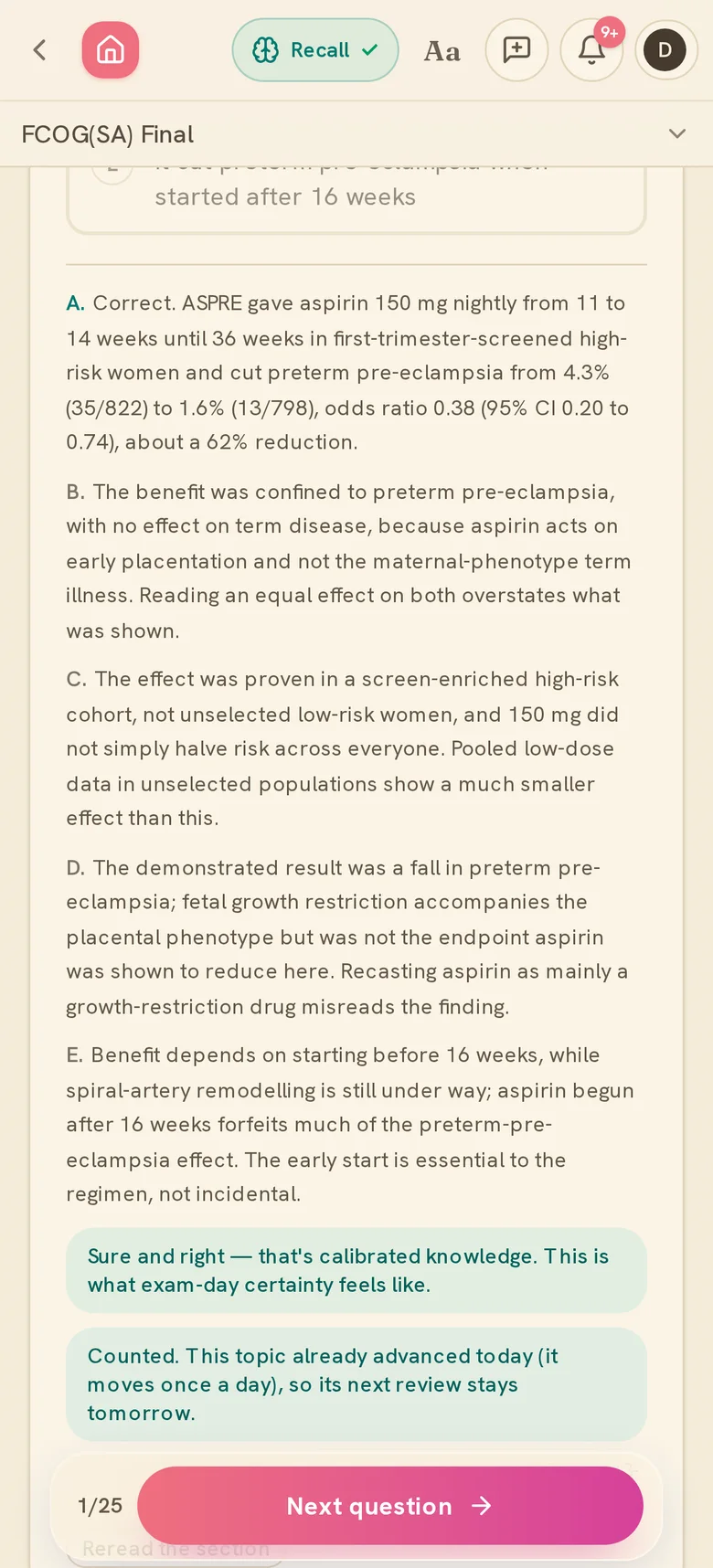
- Sure and right — "that's calibrated knowledge. This is what exam-day certainty feels like."
- Sure and wrong — the flag that this was a real gap, not a slip.
- Guessed and right — luck, not learning yet, and it is kept in your queue so the real thing can take luck's place.
That feedback loop — predict, commit, find out — is how calibration sharpens. Over a few weeks, the gap between feeling ready and being ready closes.
In a hurry? Quick mode
Some sessions you want to think slowly; some you just want to fly through on the train. One tap on Quick mode turns off the confidence check and the reflection beat — you answer, you see the explanation, you move. Your call, every session.

Jeeni reads your session, concept by concept
This is the part people feel. At the end of a session, Jeeni does not hand you a score and a shrug. She reviews your paper the way a consultant sits beside a registrar — the concepts you missed, first, and for each one she teaches the actual point, in plain language, grounded in the real explanation:
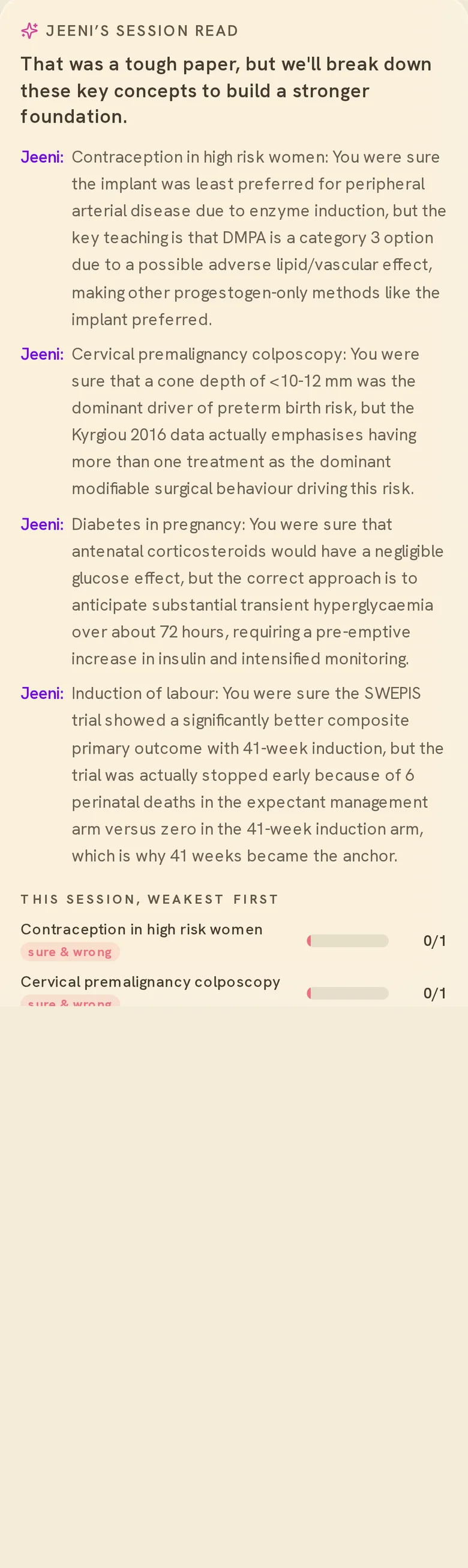
Not "revise thyroid disorders." Instead: "you were sure iodine given early causes fetal goitre, but the key is that iodine before the thionamide fuels synthesis — Jod–Basedow — and only shuts down release after blockade." The exact misconception, named and corrected, from the exact question you just did. Below it: your session, weakest first, with the sure-and-wrong ones flagged, and whether to read first (nothing landed yet) or let recall finish the job (it is nearly there).
The five ideas doing the work
Everything above is four or five well-evidenced ideas, working together:
- Retrieval practice — pulling a fact out is what stores it. Testing is studying, not just measuring it.
- Spaced repetition — each topic returns just as you are about to forget it, which is where a review does the most work. Jeeni schedules this for you.
- Interleaving — deliberately mixing topics rather than blocking one. It feels harder and is exactly why it transfers: the exam interleaves too.
- Calibration — training the match between confidence and correctness, so you trust the right instincts under pressure.
- Elaboration — generating your own "why," which builds the connections that survive a reworded vignette.
The through-line: the techniques that feel easy (re-reading, highlighting) mostly do not work; the ones that feel like effort are the ones that do. Jeeni is built to make the effortful thing the default, and the least painful version of it.
Jeeni: how to actually use this
A note from Jeeni.
Two things I want you to lean on.
Calibration is not a game — it is the difference between a registrar who is safe and one who is dangerous. When you tap Sure and turn out wrong, do not wince past it. That is the most useful sentence in your whole session. Read the explanation twice, and if you can, tell me in the reflection box why you believed the wrong thing. Naming the belief is how you dislodge it.
Elaboration feels slow because it is you doing the work instead of me. That is the point. A few honest seconds of "why is B better than my A" builds something a re-read never will — the reasoning you can carry into a question you have never seen. Write badly, write in fragments, it does not matter. The reaching is the mechanism.
So: do a short session most days, tell me the truth about how sure you are, sit with the sure-and-wrong ones, and let me bring things back when they are due. Do that for a few weeks and you will feel the change — not "I have seen this," but "I know this, and I know that I know it."
Ready when you are. Start a recall session →