In one line
Assisted reproduction is a controlled sequence — stimulate, retrieve, fertilise, culture, transfer, support, freeze — built around one dominant safety problem, ovarian hyperstimulation syndrome, which modern practice now largely designs out at the front end (antagonist protocol, agonist trigger, freeze-all) rather than rescues at the back end. The consultant task is to deliver a live birth while keeping the woman out of an OHSS bed and out of a high-order multiple pregnancy.
Mechanism & pathophysiology
A natural cycle recruits a cohort of antral follicles each month but, through falling FSH and dominant-follicle feedback, selects a single one to ovulate. Controlled ovarian stimulation overrides that selection: exogenous gonadotrophins (FSH ± LH activity) are given at a dose that keeps the whole antral cohort above the FSH threshold, so multiple follicles grow in parallel. The price of multiplicity is the entire safety problem of the field — more follicles means more granulosa-cell mass, more oestradiol, and after the trigger, more of the vasoactive mediator that drives ovarian hyperstimulation syndrome.
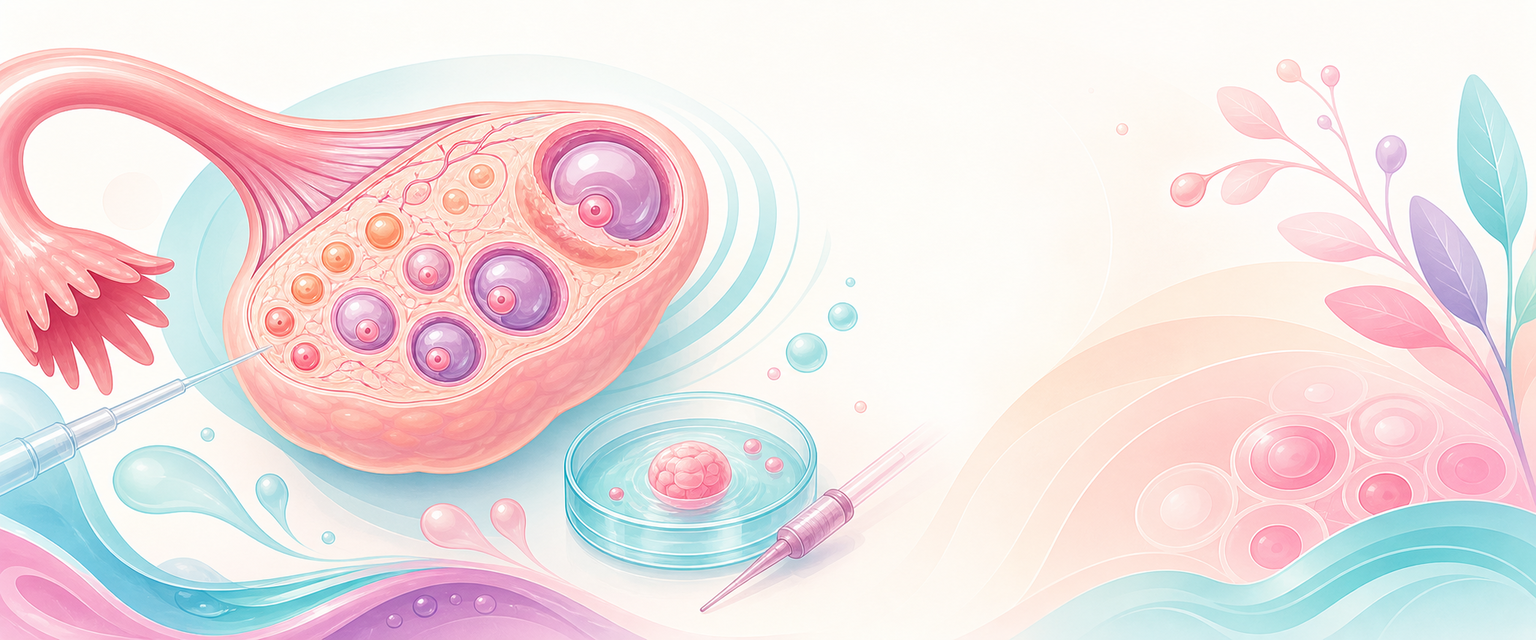
The cycle in sequence. Stimulation runs for roughly 8 to 12 days, monitored by ultrasound follicle tracking, with serum oestradiol added where clinically indicated or by local protocol rather than as a routine addition, until several of the leading follicles reach about 16 to 22 mm. A trigger then induces the final maturation that nature would have produced from the LH surge — resumption of meiosis, the leading oocytes completing the first meiotic division to metaphase II. Oocytes are aspirated transvaginally under ultrasound guidance about 34–36 hours after the trigger (timed to retrieve mature oocytes before spontaneous ovulation). In the lab, fertilisation is by conventional IVF (motile sperm co-incubated with each oocyte, fertilisation left to the sperm) or ICSI (a single sperm injected directly into the ooplasm, bypassing every natural sperm–oocyte barrier). Embryos are cultured to cleavage stage (day 2–3) or, increasingly, to blastocyst (day 5–6), which both selects the more viable embryos and synchronises better with the endometrium. One embryo is transferred, the luteal phase is pharmacologically supported because stimulation and retrieval disrupt the corpus luteum, and surplus good-quality embryos are vitrified for later frozen transfer.
Why the protocol architecture exists: preventing a premature LH surge. If the woman's own pituitary releases LH before the follicles are mature, she ovulates early and the cycle is lost. Two pituitary-suppression strategies prevent this and define the two protocols. The GnRH-agonist long protocol gives a GnRH agonist from the preceding luteal phase; after an initial flare it downregulates the pituitary, producing deep, reversible hypogonadotrophic suppression before stimulation even begins. The GnRH-antagonist protocol instead starts gonadotrophins on a natural cycle and adds a GnRH antagonist mid-stimulation (a fixed day, or flexibly once the lead follicle reaches ~14 mm), giving immediate competitive blockade of the pituitary GnRH receptor. The antagonist protocol is shorter, uses less drug, and (the decisive point) keeps the pituitary responsive, which is what makes the agonist trigger possible. Current ESHRE guidance probably favours the fixed antagonist start over the flexible one, and where a freeze-all is planned progestin-primed ovarian stimulation is a third suppression strategy, since a progestin cannot be used if a fresh transfer is intended.
The trigger is the hinge of the whole safety story. Final maturation can be triggered with hCG, which is structurally LH-like but has a long half-life, so it occupies the corpus luteum's LH receptors for days. In an agonist long-protocol cycle, hCG is the only option, because the pituitary is downregulated and cannot mount its own surge. In an antagonist cycle, you can instead give a GnRH-agonist trigger, which displaces the antagonist and provokes a short, physiological endogenous LH (and FSH) surge from the still-responsive pituitary — final maturation without days of sustained LH-receptor stimulation. That difference is the entire mechanism behind OHSS prevention.
OHSS is a vascular-permeability disease driven by hCG through VEGF. The hyperstimulated, enlarged ovaries — many corpora lutea after retrieval — secrete vascular endothelial growth factor (VEGF) in response to LH-receptor stimulation. VEGF acting on VEGFR-2 increases capillary permeability throughout the body; fluid shifts out of the intravascular space into a "third space" (ascites, pleural effusion, generalised oedema). The intravascular compartment is left contracted: haemoconcentration, a rising haematocrit, oliguria from renal hypoperfusion, electrolyte derangement, and — because the blood is concentrated and the patient often immobile — a markedly raised venous and arterial thromboembolic risk that can persist for weeks. What sustains the whole process is hCG: the LH-receptor occupancy that keeps VEGF flowing comes either from the exogenous hCG trigger (early-onset OHSS, ~3–7 days after trigger) or from endogenous hCG of an implanting pregnancy (late-onset OHSS, with onset from about 9 days after the hCG trigger, sustained by the pregnancy's own hCG and typically more severe and prolonged). Remove hCG from the equation and the disease defuses. An agonist trigger removes the exogenous source; a freeze-all (deferring transfer to a later unstimulated cycle) removes the endogenous-pregnancy source. That is why the modern preventive package targets hCG at both ends.
Assessment
The assessment task before ART is to choose the right modality for this couple, to predict ovarian response so the gonadotrophin dose and protocol fit the patient, and to stratify OHSS risk so prevention is built in from the start. This assumes the completed subfertile-couple work-up — ovulation, tubal patency and semen analysis — which is the prior step, not a re-teach here.
Choosing IUI, IVF or ICSI:
- Intrauterine insemination (IUI) ± mild ovarian stimulation suits mild male-factor or unexplained subfertility with at least one patent tube and an adequate post-wash motile count. It is cheaper and less invasive, and in South Africa it is the realistic first-line assisted treatment for many couples for whom IVF is financially out of reach — but per-cycle success is modest and it offers nothing where the tubes are blocked or sperm parameters are poor.
- IVF is indicated for tubal-factor subfertility, endometriosis, unexplained subfertility after failed lesser treatment, and anovulation resistant to ovulation induction.
- ICSI is the answer to a fertilisation problem — significant male factor (severe oligo-astheno-teratozoospermia, surgically retrieved testicular/epididymal sperm), or previous failed/poor fertilisation with conventional IVF. ICSI does not outperform conventional IVF when sperm are normal; using it indiscriminately adds cost and an invasive micromanipulation step for no fertilisation gain. The discipline is to reserve ICSI for the sperm problem it was designed to solve.
Predicting ovarian response — the AMH/AFC axis. Anti-Müllerian hormone (AMH, secreted by small antral and pre-antral follicles) and the ultrasound antral follicle count (AFC) are the two quantitative markers of the recruitable follicle pool, and ESHRE recommends either over older tests (day-3 FSH, inhibin B). They predict the extremes — who will respond poorly and who will respond excessively — far better than they predict an individual live birth, and that is exactly how to use them: to set the gonadotrophin starting dose and to flag the high responder before the first injection. A high AMH and a high AFC, especially with polycystic ovarian morphology, mark the woman who will over-recruit.
OHSS risk stratification is the assessment that changes the whole plan. The high-risk woman is identifiable in advance:
- Patient factors: polyendocrine/metabolic ovarian syndrome (PMOS, previously PCOS), high AMH (>3.4 ng/mL), high AFC (>24), young age, and a previous OHSS episode. The evidence linking body mass index to OHSS is mixed, so low body weight is not a firm criterion.
- Cycle factors (the dynamic warning): a rapidly rising or very high oestradiol, and a large number of growing follicles — a high follicle count on the day of trigger is the single most useful real-time predictor.
- The amplifier: pregnancy. Conception converts a brewing early OHSS into severe, protracted late OHSS through endogenous hCG.