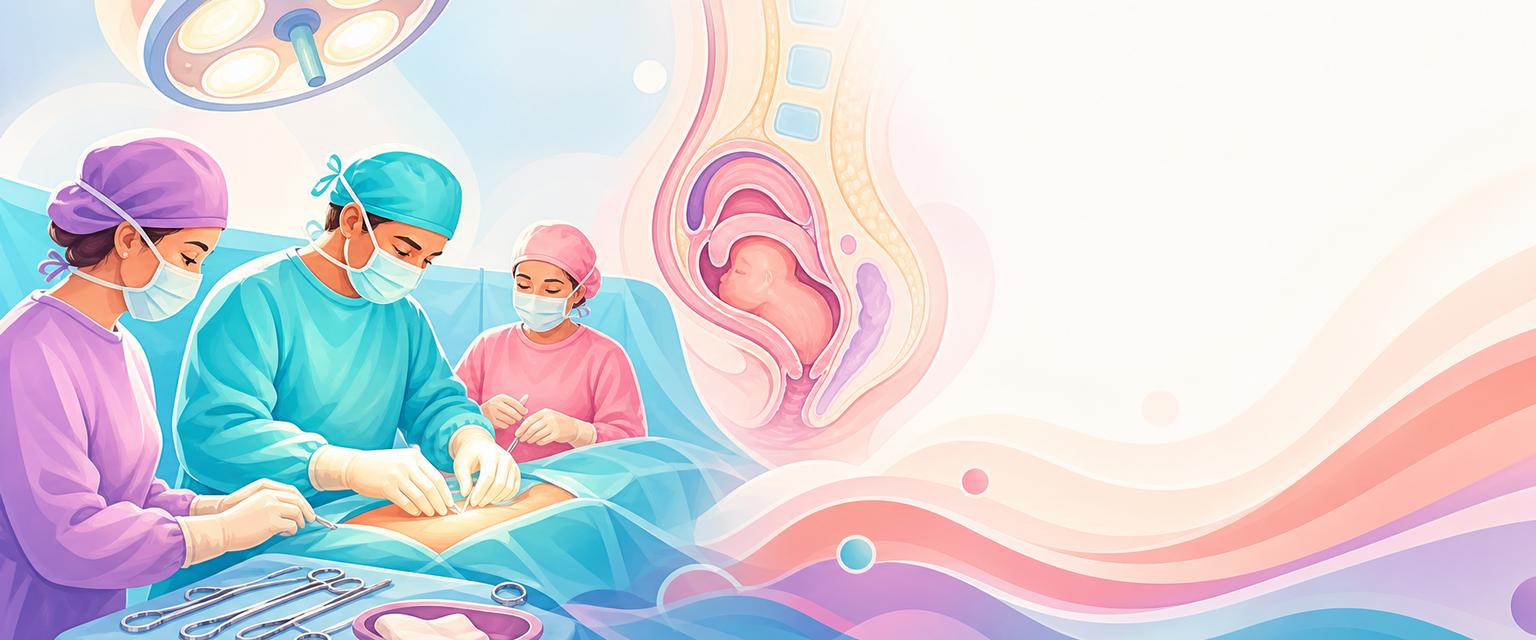
In one line
Caesarean at full dilatation is a high-morbidity operation whose defining hazard is the impacted fetal head (IFH) — and the governing principle is to anticipate impaction before you cut, assemble the team, and disimpact by flexion-and-elevation rather than brute force, favouring a "pull" (reverse breech extraction) over an isolated "push" when standard cephalic delivery fails.
This chapter assumes the operative groundwork in safe caesarean technique basics and the second-stage judgement in Prolonged second stage — it concentrates on the advanced layer: classifying the impaction subtype, the disimpaction-ladder judgement calls, and appraising a fragile, partly-retracted evidence base. Where a basic mechanism is mentioned it is stated in one line and linked down.
Assessment
The decision to operate at full dilatation is itself the first judgement, and at this level the question is why this woman is on the table at 10 cm — because that history predicts not just whether the head is impacted but which subtype of impaction you will face, and the two subtypes are managed by opposite manoeuvres.
Classify the impaction before you scrub — there are two mechanically distinct subtypes that the basic account does not separate:
- The deeply impacted (insinuated) head — the wedged, jammed head. Defined clinically by immobility of the cephalic pole on vaginal examination and the absence of any space between the fetal head and the pubic symphysis. The vertex sits at or below the spines with significant caput and moulding, often after a long active second stage or a failed instrumental attempt. The mechanical problem is that the head is deflexed and impacted behind the symphysis; the solution is to get below it, flex it, and elevate it — and if that fails, to reach past it for the feet (reverse breech extraction, a "pull"). This is the classic IFH.
- The floating / non-insinuated high head — the opposite problem, and the trap. Defined by a head at or above the De Lee −3 plane — most often a CS performed in early labour before engagement, abdomino-pelvic disproportion, or a malposition or high presenting part that never entered the pelvis (deep transverse arrest, by contrast, is an engaged mid-cavity head and belongs with the jammed-low subtype, not here). Here a "push from below" is useless (there is nothing to push against) and reaching past the head for the feet is awkward because the head fills the upper segment. The correct manoeuvre is internal podalic version: a hand passes deep into the uterus, grasps one or both ankles, and the fetus is delivered as a breech while the head is guided up toward the fundus — essentially the second-twin manoeuvre applied through a hysterotomy. Misreading a floating head as a "deeply impacted" one and ordering a vaginal push is a setup for a long, traumatic extraction.
The governing link: station defines the subtype, and the subtype defines the manoeuvre. A head jammed below the spines → flex/elevate, then pull (RBE). A head floating above De Lee −3 → internal podalic version. Reaching to push the head up without first establishing where the head is skips the distinction that decides the operation.
- History that predicts impaction (and its severity): prolonged active second stage, oxytocin augmentation, malposition (OP/OT/deep transverse arrest), and — critically — a failed or abandoned assisted vaginal birth. More than half of IFH cases follow a failed instrumental attempt. Macrosomia and a deeply engaged head with significant caput/moulding compound the risk. A large registry cohort (Ammitzbøll et al., EJOGRB 2023; n=2332) quantified independent risk factors for difficult fetal extraction: deep descent (head at the spines aOR ≈ 2.5, at the pelvic floor aOR ≈ 3.1), high pre-pregnancy BMI (aOR ≈ 1.4), anterior placenta (aOR ≈ 1.4) and top-up epidural rather than spinal anaesthesia (aOR ≈ 1.4) — and difficult extraction roughly tripled–quadrupled the odds of cord pH ≤ 7.09 and of major maternal blood loss. The mechanism→consequence chain is: deep descent → impaction → forceful extraction → lower-segment laceration extending to the angles/broad ligament → torrential bleeding and a compressed, acidotic fetus.
- Examination at decision: abdominal fifths palpable, vaginal station, position and degree of moulding (3+ sagittal moulding signals cephalo-pelvic disproportion in SA NDoH/SASOG practice), and whether the head recedes on relaxation. A head that will not be displaced abdominally at the start of the case is the warning that you will need advanced manoeuvres — decide then, while the patient is calm and the team is assembling, not mid-laceration.
- Investigations: group-and-save with crossmatch availability (incision extension and atony drive blood loss), and confirm a neonatal resuscitation team and senior obstetric presence. IFH is unpredictable: the RCOG position is that no antenatal or intrapartum variable reliably forecasts it, so vigilance — not a score — is the safeguard. Interpret a "trial of instrumental in theatre" not as a soft option but as a setup that, if it fails, hands you a more impacted head than the one you started with.
Severity stratification and the judgement call. There is no validated numerical IFH severity score. What you do stratify on is a triad: station/subtype (above De Lee −3 vs jammed below the spines), the preceding insult (virgin uterus vs failed Kielland's/ventouse with a battered lower segment), and the field you are operating in (a thinned, ballooned lower segment after prolonged obstructed labour, possibly with a Bandl's ring, tears far more readily). A deeply-impacted head after a failed instrumental in a Bandl-ringed obstructed labour is the highest-acuity version — assemble maximal seniority and have the disimpaction ladder rehearsed before the knife touches skin.
Management
Management runs immediate (pre-incision preparation) → intra-operative (the disimpaction ladder) → ongoing/long-term (complications and the next pregnancy).
Immediate — before the knife. Declare the anticipated difficulty in the WHO safety brief and name it: "anticipated impacted fetal head, I want a second obstetrician, neonatal team, and an assistant gowned for a vaginal manoeuvre." Stop any oxytocin infusion. Have GTN drawn up (the consultant dose, below), a step for the operator, and a trained assistant gowned and ready to assist vaginally. Position matters: reposition the legs in semi-lithotomy (knees flexed, thighs abducted) so a whole hand can reach the head from below — the act of repositioning sometimes releases the impaction itself. Choose the abdominal incision deliberately: a thinned, over-distended lower segment after obstructed labour tears unpredictably, so plan the uterine entry high enough to avoid extending into a Bandl's ring or the cervix.
Intra-operative — the disimpaction ladder (escalate like a shoulder-dystocia drill; there is no single mandated technique). Note that steps 3–5 are subtype-specific, not a fixed sequence — pick the limb that matches the impaction you classified at assessment:
| Step | Technique | Key points (SIP No. 73, 2nd ed.) |
|---|---|---|
| 1 | Abdominal cephalic disimpaction | Get below the head, flex (smallest AP diameter), elevate towards the incision calmly; effective in most cases. Inadvertent pressure on the lower-segment angles here is what tears toward the broad ligament/cervix — control the pressure, do not jam. |
| 2 | Tocolysis | Short-half-life agent — IV GTN (nitroglycerin) 50 µg, repeatable up to four further times at 60-second intervals — to relax the lower segment; anecdotal benefit, no RCT support, mind the atony/PPH risk and have a uterotonic ready. |
| 3 | Vaginal disimpaction ("push") — deeply impacted head | Assistant uses a whole cupped hand ("Pringle hand") in the sacral hollow — never one or two fingertips (linked to skull fracture). Steady, even flexion-elevation with closed-loop communication; abandon if no progress. Best suited to a head jammed below the spines. |
| 4 | Reverse breech extraction ("pull") — deeply impacted head | Reach the upper segment, grasp one/both feet, traction to deliver breech, Løvset for arms, Mauriceau-Smellie-Veit for the head. The maternal-morbidity winner where push fails; the named hazard is iatrogenic long-bone fracture if traction is rough on the femur/humerus. |
| 5 | Internal podalic version — floating / non-insinuated head | For a head above De Lee −3: hand to the fundus, grasp ankle(s), deliver as a breech while guiding the head upward. The correct answer when there is nothing to push against — distinct from RBE. |
| 6 | Patwardhan method | Arms-first variant when the back is accessible (variants for anterior, lateral and posterior fetal back): deliver the arms/shoulders first, then trunk, then breech, then head — without direct head manipulation. Assistant gives fundal pressure. Specialist skill, well described in South-Asian practice, rarely taught in UK/SA. |
| 7 | Extend the incision | Inverted-T or J incision, or deliberate division of a Bandl's ring, protecting the fetus with the non-dominant hand — a planned decision, not a torn extension you discover. |