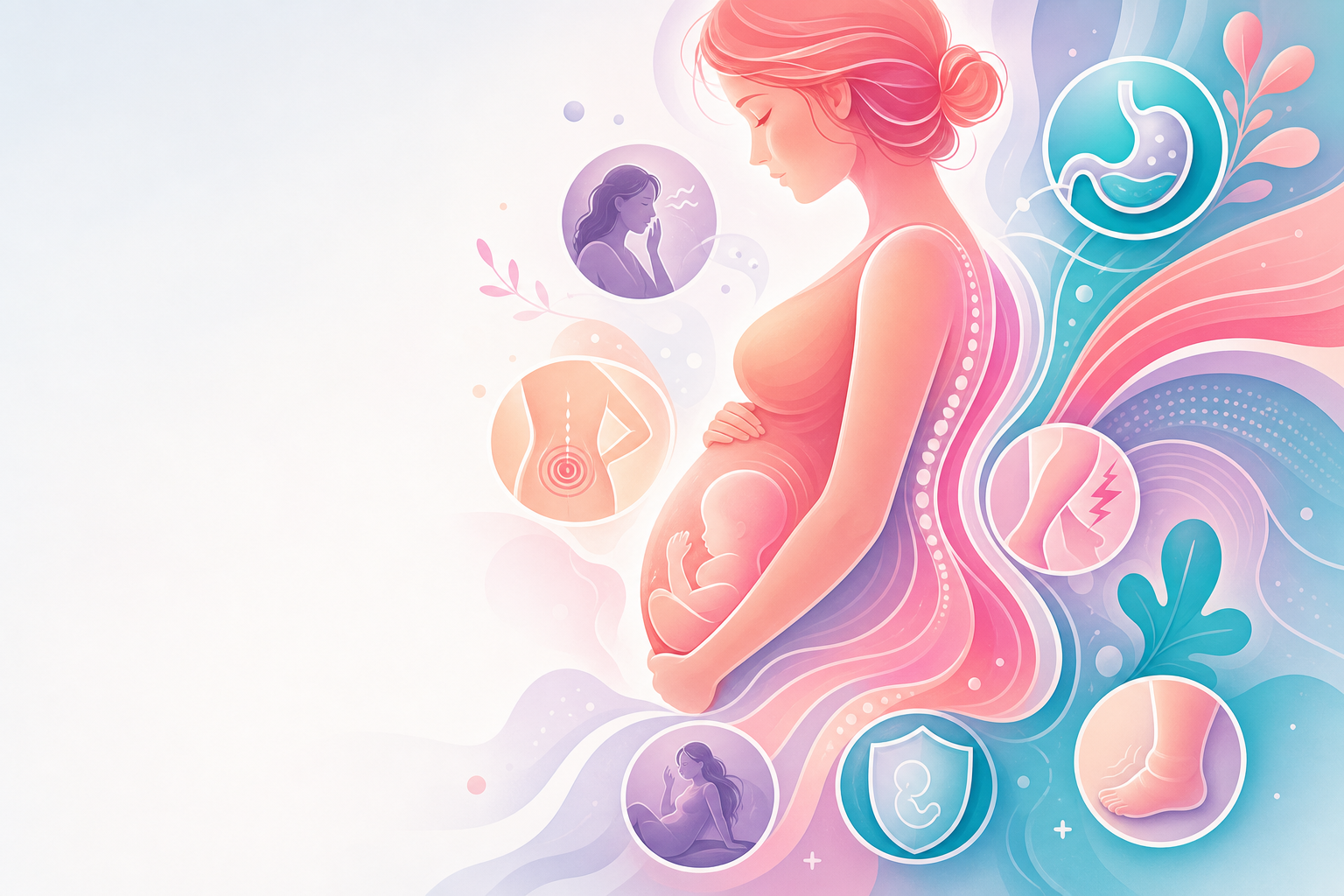
Clinical overview
"Minor complaints" is the umbrella term for the common, self-limiting symptoms of normal pregnancy: nausea and vomiting, heartburn, constipation, backache, varicose veins, haemorrhoids, leg cramps, carpal tunnel syndrome, ptyalism, fatigue, and the breast, skin and pelvic-girdle changes that almost every pregnant woman experiences. They are "minor" only in the sense that they do not usually threaten mother or fetus — to the woman experiencing them they are a daily reality, and they account for a large share of antenatal consultations. For the registrar, the objective verb is describe: you must know the mechanism, the expected gestation, the safe symptomatic remedies, and — crucially — the red-flag conditions that masquerade as a minor complaint.
The exam-and-clinic skill here is twofold. First, normalise and treat the genuinely minor symptom with the simplest safe measure, so the woman is not over-investigated or over-medicated. Second, and more important for safety, never let a minor-complaint label anchor you onto a sinister diagnosis: vomiting can be hyperemesis or a surgical abdomen; "heartburn" in the third trimester can be the epigastric pain of pre-eclampsia; breathlessness can be physiological or a pulmonary embolus; "indigestion" can be myocardial ischaemia. In the South African setting, where many women book late and the antenatal visit may be the only health contact, the minor-complaint consultation is also a screening opportunity — for hypertension, anaemia, HIV and depression. This chapter pairs naturally with antenatal-booking, pregnancy-nutrition and respectful-care.
Core knowledge
The minor complaints arise from three engines of normal pregnancy physiology: the hormonal milieu (high progesterone, oestrogen, hCG, relaxin), the enlarging gravid uterus (mechanical pressure and altered posture), and the expanded plasma volume and cardiovascular adaptation. Understanding the engine lets you predict the symptom, its timing, and its rational treatment.
Figure I10.1 — The three physiological engines behind minor pregnancy complaints and the screening discipline that prevents anchoring.
Nausea and vomiting of pregnancy (NVP)
The commonest complaint, affecting up to ~70–80% of pregnancies (standard teaching). It typically starts before 9 weeks, peaks around 9–11 weeks, and resolves by ~16–20 weeks. The pathophysiology is incompletely understood but is associated with rising hCG (hence worse in multiple and molar pregnancy) and oestrogen; the gene GDF15 has emerged as a strong mechanistic link (recent research, flag as evolving). NVP exists on a spectrum: at the severe end is hyperemesis gravidarum — protracted vomiting with dehydration, ketonuria, electrolyte disturbance and weight loss (classically >5% of pre-pregnancy weight) — which is no longer "minor" and is covered by medical-complications-in-pregnancy. The PUQE score (Pregnancy-Unique Quantification of Emesis) grades severity and guides escalation.
Gastro-oesophageal reflux / heartburn
Affects a majority by the third trimester. Progesterone relaxes the lower oesophageal sphincter and slows gastric emptying; the enlarging uterus raises intra-abdominal pressure and displaces the stomach. The result is retrosternal burning, worse lying flat and after meals.
Constipation and haemorrhoids
Progesterone reduces gut smooth-muscle motility; the gravid uterus compresses the rectosigmoid; oral iron supplements worsen it. Straining and venous congestion from the enlarging uterus and raised progesterone produce or aggravate haemorrhoids, which often flare in late pregnancy and the early puerperium.
Musculoskeletal: backache and pelvic-girdle pain
Relaxin and progesterone loosen pelvic ligaments and the symphysis pubis; the growing uterus shifts the centre of gravity forward, producing a compensatory lumbar lordosis. Pelvic-girdle pain (symphysis pubis dysfunction) is pain over the symphysis and sacroiliac joints, worse on weight-bearing, standing on one leg and turning in bed.
Venous and circulatory complaints
Raised venous pressure in the lower limbs (uterine caval compression, progesterone-mediated venodilation, increased blood volume) produces varicose veins, ankle oedema and vulval varicosities. Supine hypotensive syndrome — dizziness, pallor and faintness when lying flat — is caval compression by the gravid uterus, relieved by left lateral tilt. Dependent oedema is physiological; it becomes a red flag when it is sudden, facial, or accompanied by hypertension or proteinuria.
Other common complaints
- Leg cramps — painful nocturnal calf cramps, common in the second half of pregnancy; mechanism uncertain.
- Carpal tunnel syndrome — fluid retention compresses the median nerve, giving nocturnal hand paraesthesiae and weakness; usually resolves postpartum.
- Ptyalism — excessive salivation, often with NVP.
- Fatigue and sleep disturbance — progesterone is sedating early; nocturia, reflux and discomfort fragment sleep later.
- Breast changes — tenderness, enlargement, Montgomery tubercles, colostrum.
- Skin changes — linea nigra, melasma (chloasma), striae gravidarum, spider naevi and palmar erythema; pruritus is common but generalised itching, especially of palms and soles without a rash, must trigger evaluation for obstetric cholestasis (a non-minor diagnosis).
- Urinary frequency — early from uterine pressure and increased GFR, late from fetal head engagement; distinguish from urinary tract infection.
- Breathlessness — physiological hyperventilation of pregnancy (progesterone-driven) is common and benign, but is a diagnosis of exclusion.
Assessment
The assessment of a minor complaint is a focused history and examination whose primary purpose is to separate the physiological from the pathological. Establish the symptom, its gestation of onset, severity, and impact on function, then actively screen for the red-flag features that change the diagnosis.
History
- Characterise the symptom: onset gestation, pattern, severity, triggers, relieving factors, functional impact (work, sleep, eating, mobility).
- For NVP: frequency of vomiting, ability to keep fluids down, weight change, ketosis symptoms; calculate or estimate a PUQE category.
- Screen for danger features with every complaint: headache, visual disturbance and epigastric/right-upper-quadrant pain (pre-eclampsia); fever, dysuria, loin pain (pyelonephritis); calf pain/swelling, pleuritic chest pain, breathlessness at rest (VTE); per-vaginal bleeding or fluid; reduced fetal movements; pruritus of palms/soles (cholestasis).
- Mental-health screen: persistent low mood, anhedonia and anxiety are common and under-recognised — see gbv-mental-health-pregnancy.
Examination
- Vital signs every visit — blood pressure and urine dipstick are non-negotiable, because the cheapest way to miss pre-eclampsia is to accept "third-trimester heartburn" at face value.
- Symphysis-fundal height, lie, presentation and fetal heart as appropriate to gestation.
- Targeted examination guided by the complaint: legs for varicosities/oedema/calf tenderness; abdomen for surgical signs if vomiting is atypical; reflexes/clonus if pre-eclampsia is suspected.
Investigations
Most minor complaints need no investigation — over-investigation is itself a pitfall. Investigate only to exclude a mimicking pathology or when severity warrants it:
- NVP/hyperemesis: urine dipstick for ketones, MSU to exclude UTI; if severe — U&E, FBC; consider an ultrasound to confirm viability and exclude multiple/molar pregnancy.
- Suspected pre-eclampsia: BP, urine protein (dipstick → protein:creatinine ratio), FBC, U&E, LFTs, urate.
- Suspected cholestasis (itching palms/soles): LFTs and bile acids.
- Suspected UTI/pyelonephritis: urine dipstick + MSU culture.
- Anaemia as a cause of fatigue/breathlessness: FBC (per antenatal-booking and the SA visit schedule).
- Suspected VTE: this is an emergency pathway — do not "watch" a swollen tender calf or a breathless woman as a minor complaint.
Management
The governing principle is a stepwise, conservative ladder: reassurance and explanation first, then lifestyle and non-pharmacological measures, then the safest effective medicine, reserving referral for failure or red flags. Always frame management within respectful-care — these symptoms are real and dismissive language ("it's just pregnancy") erodes trust.

Figure I10.2 — Stepwise management for common minor complaints in pregnancy, from validation and safety screening to referral.
Nausea and vomiting
- Conservative: small frequent carbohydrate snacks, avoid trigger foods/smells, oral hydration, rest. Ginger has modest evidence and is safe. Acupressure (P6 wristbands) may help.
- Antiemetics: NICE NG201 recommends offering antiemetics if conservative measures fail, reassuring women they are safe. First-line agents in standard practice and on the SA EML include antihistamines (e.g. promethazine, cyclizine) and dopamine antagonists (e.g. metoclopramide — short-term, watch extrapyramidal effects). Pyridoxine (vitamin B6) ± doxylamine is a recognised first-line combination internationally. Use locally available, EML-listed agents; confirm exact doses against the current SA EML / NDoH guideline before prescribing.
- Escalate to hyperemesis-gravidarum care (IV rehydration, thiamine to prevent Wernicke's encephalopathy, electrolyte correction, thromboprophylaxis if admitted) when there is dehydration, ketonuria or weight loss — this crosses out of "minor".
Heartburn / reflux
Lifestyle first: smaller meals, avoid late or fatty/spicy meals, sleep propped up. Step up to antacids/alginates (the standard first pharmacological step). If symptoms persist, acid-suppression can be added; NICE NG201 supports antacids and, where needed, acid-suppressing drugs.
Constipation and haemorrhoids
Increase dietary fibre and fluids and encourage activity; if iron is the culprit, review the preparation. Use a bulk-forming laxative first, then an osmotic agent (e.g. lactulose) if needed; avoid stimulant laxatives long-term. For haemorrhoids: dietary measures to soften stool, topical soothing preparations, and reassurance that they usually regress after delivery; refer for persistent or thrombosed lesions.
Musculoskeletal pain
For backache and pelvic-girdle pain: physiotherapy, an exercise programme, a support belt, advice on posture, lifting and turning in bed, and paracetamol as the analgesic of choice. Avoid NSAIDs, especially in the third trimester (risk of premature ductus arteriosus closure and oligohydramnios) — standard teaching. Reassure that pelvic-girdle pain usually resolves postpartum.
Leg cramps, oedema and varicose veins
Stretching and calf exercises for cramps. For varicose veins and dependent oedema: leg elevation, avoiding prolonged standing, and graduated compression stockings; reassure that varicosities often improve postpartum. Teach left lateral positioning for supine hypotension. Persistent compression stockings are first-line; venous surgery is deferred to after pregnancy.
Carpal tunnel, ptyalism, fatigue, skin and breast changes
Wrist splints (especially nocturnal) for carpal tunnel, with reassurance of postpartum resolution. Reassurance and explanation for ptyalism, fatigue, breast tenderness and the normal skin changes; well-fitting supportive bras; sun protection for melasma. Explain that striae fade but do not disappear.
South African context
- The NDoH National Integrated Maternal and Perinatal Care Guideline (NDoH, 2024) sets the SA antenatal visit schedule and the package of care; medicines must come from the relevant SA EML level (primary-care vs hospital level). Use EML-listed antiemetics, antacids and analgesics, and confirm doses against the current EML before prescribing.
- Levels of care: minor complaints are managed at the primary/district clinic by midwives and medical officers; referral to regional/tertiary care is for the red-flag conditions (severe hyperemesis needing admission, suspected pre-eclampsia, VTE, cholestasis, surgical abdomen) — see sa-maternity-guidelines and high-risk-pregnancy-risks.
- HIV: many antenatal attendees are living with HIV on TLD-based ART (SA ART guidelines). Nausea and gastrointestinal upset can also be drug- or opportunistic-infection-related, not simply NVP — keep HIV status and ART in mind when symptoms are atypical or persistent. See hiv-in-pregnancy.
- The antenatal contact is a screening opportunity: every minor-complaint visit should still deliver BP, urine dipstick, anaemia and mental-health screening, because for many women it is their only health contact (see antenatal-booking).
Emergency drill — the mimics that are NOT minor
A minor complaint that is actually an emergency must be recognised and escalated immediately. STOP and escalate when:

Figure I10.3 — Red-flag mimics that convert a minor-complaint visit into urgent obstetric, medical or surgical escalation.
- "Heartburn"/epigastric or right-upper-quadrant pain + raised BP or proteinuria → treat as pre-eclampsia/imminent eclampsia: lie left, IV access, bloods (FBC, U&E, LFTs, urate), control BP, give magnesium sulphate for severe pre-eclampsia/eclampsia, and transfer urgently. Follow pre-eclampsia-and-hellp.
- Breathlessness at rest, pleuritic chest pain, or a swollen tender calf → suspected pulmonary embolism / DVT: oxygen, urgent assessment and imaging, and do not delay therapeutic anticoagulation while investigating.
- Vomiting with abdominal pain, distension, guarding or absent bowel sounds → suspected surgical abdomen (appendicitis, obstruction): surgical referral, nil by mouth, IV fluids.
- Persistent itching of palms and soles without a rash → check bile acids and LFTs for obstetric cholestasis (a recognised stillbirth risk).
- Severe protracted vomiting with dehydration/ketonuria → admit for hyperemesis management, with IV thiamine before any glucose to prevent Wernicke's encephalopathy.
Red flags / pitfalls
- Anchoring on "minor": the single most dangerous error. Epigastric pain is pre-eclampsia until proven otherwise; calf pain is VTE until excluded; breathlessness needs a cause before it is called physiological.
- Skipping the BP and urine dipstick because the complaint sounds trivial — this is how pre-eclampsia is missed.
- NSAIDs in pregnancy for backache or cramps — avoid, especially the third trimester (ductal constriction, oligohydramnios). Use paracetamol.
- Over-investigation and over-medication of genuinely physiological symptoms — wastes resources and medicalises normality; reassurance is a treatment.
- Mislabelling hyperemesis as morning sickness — failing to check ketones and weight, and missing dehydration, electrolyte derangement and the (rare but devastating) Wernicke's encephalopathy from unsupplemented glucose.
- Dismissing the woman's distress — calling symptoms "just pregnancy" breaches respectful-care and loses the chance to detect the antenatal depression hiding behind fatigue and poor sleep.
- Forgetting drug and HIV context — attributing all GI symptoms to NVP when ART side-effects or an opportunistic infection may be responsible.
- Treating new third-trimester "frequency/dysuria" casually — exclude UTI/pyelonephritis, a recognised cause of preterm labour and maternal sepsis.
- Ignoring sudden, facial or rapidly progressive oedema — physiological dependent oedema is gradual; sudden facial/hand swelling points to pre-eclampsia.
Evidence anchors
- NDoH National Integrated Maternal and Perinatal Care Guideline (NDoH, 2024) — the South African source of truth for the antenatal package, visit schedule, screening and referral levels.
- South African EML (primary-care and hospital level, current edition) — source for the specific antiemetic, antacid and analgesic agents and doses; confirm before prescribing.
- NICE NG201 — Antenatal care (2021) — recommendations on common symptoms in pregnancy, including reassurance and stepped management of nausea and vomiting, heartburn/reflux, constipation, haemorrhoids and pelvic-girdle pain.
- RCOG Green-top Guideline No. 69 — Hyperemesis gravidarum — for the severe end of the NVP spectrum, including PUQE-graded severity and escalation (the boundary where NVP stops being a minor complaint).
- NICE NG133 — Hypertension in pregnancy (2019) and pre-eclampsia-and-hellp — for the pre-eclampsia mimic of "third-trimester heartburn"/epigastric pain.
- SA ART / HIV Consolidated Guidelines (current) and hiv-in-pregnancy — context for GI symptoms in women on ART.
- Saving Mothers / NCCEMD (latest triennium) — reinforces that hypertension and VTE (among the conditions that can hide behind minor complaints) are leading SA maternal-death causes, justifying the BP/dipstick discipline at every visit.
Author's note on hedged facts: prevalence figures (NVP ~70–80%), NVP timing (onset <9 weeks, peak ~9–11 weeks, resolution ~16–20 weeks), the >5% weight-loss threshold for hyperemesis, the GDF15 mechanism, the third-trimester NSAID caution, and the specific stepwise drug choices are stated as standard textbook teaching and are not individually line-itemed in docs/VERIFIED-SOURCES.md; exact agents and doses must be confirmed against the current SA EML / NDoH 5th-ed guideline before clinical use.
