Touch lab
Build a tolerant, defended interface
Balance trophoblast identity, regulatory tone and complement without switching maternal defence off.
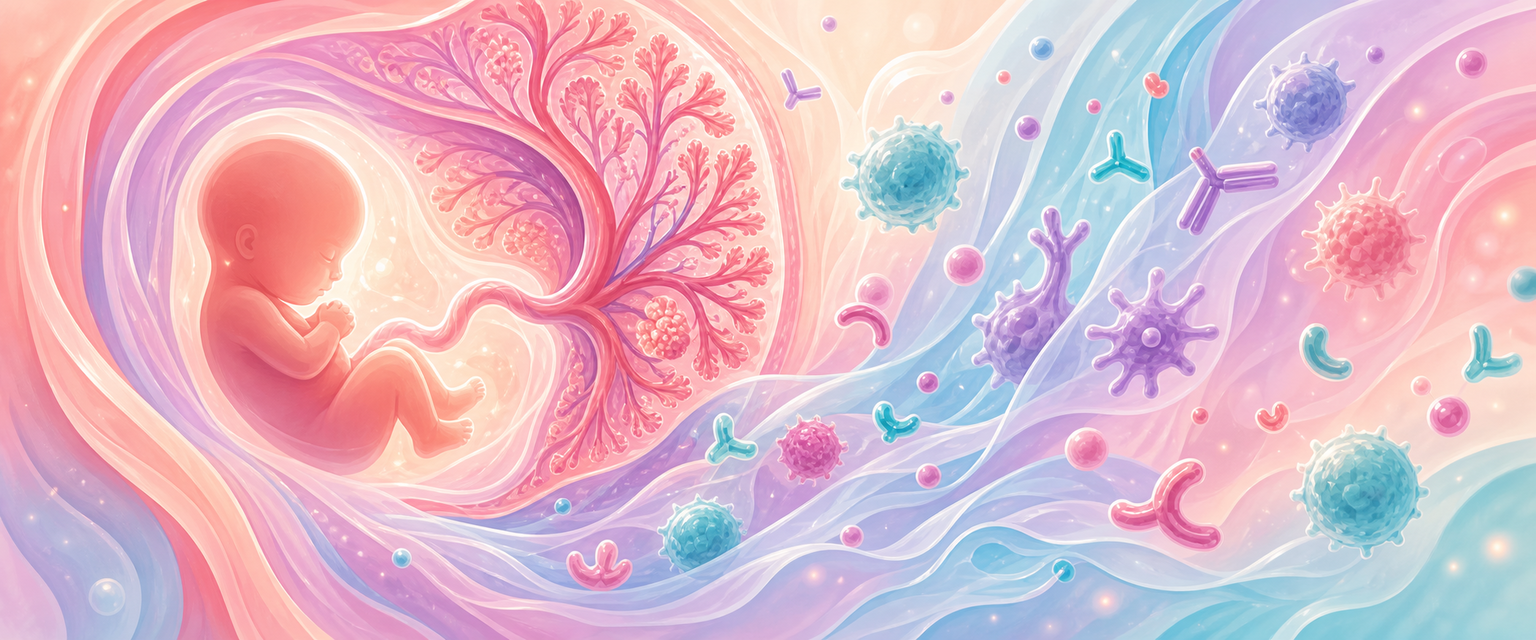
Interactive maternal-fetal interface diagram balancing immune tolerance, vascular remodelling and antimicrobial defence.The Fetus as an Allograft and Maternal-Fetal Immune Tolerance
Start from one sentence and build everything from it: a pregnancy is a foreign tissue that must be allowed to invade the mother, grow inside her for nine months, and then leave — without being destroyed and without disarming her against everything else. Every mechanism in this chapter is one of two things: a way to license that controlled invasion, or a way to keep defence intact while it happens.
The fetus is often called a semi-allograft because it carries paternal antigens foreign to the mother. (A graft sharing antigens with the host is semi-allogeneic; the fetus inherits half its genome from the father, so half of its transplantation antigens are non-self to the mother.) That phrase is useful only if it does not lead to the wrong conclusion. Pregnancy is not successful because the maternal immune system is "switched off". It is successful because the maternal-fetal interface is actively organised to allow implantation, trophoblast invasion, placental blood flow and fetal growth while still defending mother and fetus from infection.
So replace the slogan with a four-part model, and notice that each part maps onto a later disease:
immune recognition is controlled, tissue invasion is licensed but limited, inflammation is timed, and maternal defence remains active
- Recognition controlled fails → alloimmunisation (Rh/Kell disease), autoantibody fetal injury.
- Invasion licensed but limited fails → too shallow gives pre-eclampsia and fetal growth restriction; the abnormally deep, adherent end of the spectrum is the accreta concept.
- Inflammation timed fails → preterm labour, PPROM, chorioamnionitis when inflammation fires early or in the wrong place.
- Defence active fails → congenital and ascending infection.
This chapter is therefore the bridge between basic immunology and pre-eclampsia, fetal growth restriction, recurrent pregnancy loss concepts, Rh disease, infection, vaccination, autoimmune disease and transplant-style thinking in O&G. We will build it from the simplest idea (the interface is a controlled border, not a closed wall) up to the immune-vascular origins of pre-eclampsia and the dual nature of antibody traffic.
Pregnancy immunity also changes with time:
| Pregnancy window | Dominant immune task | O&G meaning |
|---|---|---|
| Implantation and early decidualisation | controlled inflammation, tissue remodelling and trophoblast entry | too little or wrongly timed inflammation can impair implantation; too much can damage tissue |
| First trimester placentation | decidual NK/macrophage/trophoblast dialogue and spiral-artery remodelling | later pre-eclampsia/FGR risk can begin before symptoms |
| Mid-pregnancy growth phase | relative immune quiescence with active defence | placenta must grow and exchange while infection surveillance continues |
| Late pregnancy and labour | inflammatory activation, cervical ripening and membrane/uterine activation | inflammation is physiological at term but pathological if premature or infected |
| Postpartum | withdrawal of placental signals and immune re-equilibration | autoimmune flares and infection/thrombosis risks can change after birth |
The exam danger is a single slogan. Pregnancy is not Th2 only, immunosuppressed only, or transplant tolerance only. It is a stage-specific immune programme.
Before going deeper into mechanism, it helps to dismantle the most common single-slogan answer head-on, because once you see why it is incomplete you will not be tempted to use any other slogan in its place.
The Th1 to Th2 Shift: Useful Shortcut, Unsafe Full Explanation
Older teaching often says successful pregnancy involves a shift from Th1-type cellular inflammation toward Th2-type humoral/anti-inflammatory dominance. That idea is still worth knowing because it explains several exam statements:
It is called older teaching because the Th1/Th2 pregnancy hypothesis was framed in the early cytokine era, classically by Wegmann et al. in 1993. That model helped candidates understand why excessive cellular inflammation could threaten fetal tolerance. Later work did not make the idea useless; it made it too small. Reviews such as Saito et al. 2010 expanded the framework to Th1/Th2/Th17/Treg, while later maternal-fetal-interface reviews describe a broader network of decidual NK cells, macrophages, dendritic cells, trophoblast HLA-C/E/G, Tregs, immune checkpoints, complement, chemokine control and stage-specific inflammation rather than a binary Th1-to-Th2 switch.
| T helper pattern | Typical cytokine/immune emphasis | Pregnancy relevance |
|---|---|---|
| Th1 | IFN-gamma, IL-2, macrophage activation, cytotoxic cellular immunity | useful for intracellular infection and TB/viral defence, but excessive decidual Th1-type inflammation can damage trophoblast, vessels and membranes |
| Th2 | IL-4, IL-5, IL-10, B-cell/antibody support and anti-inflammatory tone | supports tolerance concepts and antibody-mediated protection, but does not explain all pregnancy immunity |
| Th17 | IL-17, neutrophil recruitment and mucosal inflammation | important in infection defence and inflammatory pregnancy complications when excessive |
| Treg | FOXP3-linked regulatory function, IL-10/TGF-beta-rich restraint | central to fetal-antigen tolerance and prevention of destructive effector responses |
The useful Primary phrasing is:
normal pregnancy tends to restrain excessive Th1-type cytotoxic/inflammatory responses at the maternal-fetal interface and supports Th2/Treg-skewed tolerance, but it is not a global Th2 state
Why the old slogan is incomplete:
- implantation and labour require controlled inflammation, so "Th1 is bad" is false;
- TB, HIV, influenza, CMV and other infections still require competent cellular immunity;
- Th17 and innate pathways matter in chorioamnionitis, PPROM, sepsis and autoimmune disease;
- decidual NK cells and macrophages shape placentation without fitting neatly into Th1/Th2;
- antibody-mediated diseases such as SLE, APS, Graves disease, anti-Ro/La disease and alloimmunisation can be dangerous despite a Th2-tolerance concept.
Clinically, this is why some Th1-dominant autoimmune diseases may improve during pregnancy and flare postpartum, while antibody/complement-mediated diseases can remain active or worsen. The exam-safe answer is not "pregnancy is Th2"; it is stage-specific immune adaptation with relative Th2/Treg bias at the interface, preserved host defence, and regulated inflammatory windows.
The Three Immune Jobs of Pregnancy
Pregnancy immunity has three simultaneous jobs. If a candidate only says "tolerance", the answer is incomplete.
| Immune job | What pregnancy needs | What happens if it fails |
|---|---|---|
| Accept the fetal-placental unit | prevent destructive responses to paternal/fetal antigens | loss, placental inflammation or impaired implantation concepts |
| Build the placenta | permit trophoblast invasion and spiral-artery remodelling | pre-eclampsia, FGR and placental insufficiency phenotypes |
| Defend against infection | maintain maternal and fetal protection | ascending infection, congenital infection, sepsis, preterm birth |
These jobs compete. Too little inflammation impairs implantation and defence. Too much inflammation can damage membranes, placenta or fetal tissues. Too little trophoblast invasion gives poor uteroplacental flow; too much invasion would be biologically dangerous. Normal pregnancy is therefore a controlled negotiation, not immune silence.
Recognition without Rejection
The mother is exposed to fetal and placental information in several ways:
| Exposure route | What the immune system sees | Why rejection does not automatically follow |
|---|---|---|
| Trophoblast at the interface | paternal and placental antigens in a specialised cell type | unusual HLA pattern and local regulatory signals |
| Cell-free fetal DNA and vesicles | placental nucleic acids/proteins in maternal blood | triggers screening and immune signalling, not necessarily tissue attack |
| Fetomaternal haemorrhage | fetal red cells and platelets | can immunise mother if not prevented, as in Rh disease |
| Transplacental IgG traffic | maternal antibodies entering fetal circulation | protective for infection, harmful if directed at fetal antigens/tissues |
| Microchimeric cells | small numbers of fetal cells persisting in mother and maternal cells in fetus | usually tolerated, but may influence later immune biology |
Tolerance is therefore selective. The mother can tolerate trophoblast while still making clinically important antibodies after fetal red-cell exposure.
The key word in that table is microchimerism: small numbers of fetal cells cross into the mother (and some maternal cells into the fetus) and can persist for years, even decades, after delivery. For the Primary, the take-home is conceptual rather than clinical — the existence of long-lived, generally tolerated foreign cells is direct evidence that the maternal-fetal relationship is one of managed coexistence, not sterile separation. It also reframes why exposure does not equal rejection: the immune system clearly sees fetal material, decides how to respond, and usually files it under "tolerate" rather than "attack".
Why a Simple Transplant Analogy Fails
An organ transplant is a vascularised tissue graft placed into a host. The fetus and placenta are different:
- the main contact surface is specialised trophoblast, not ordinary fetal tissue;
- the placenta lacks lymphatic drainage like typical transplanted tissue;
- trophoblast expresses an unusual HLA pattern;
- decidua is hormonally transformed tissue built for pregnancy;
- maternal immune cells at the interface are specialised, not simply aggressive infiltrates;
- fetal cells and cell-free fetal DNA enter the maternal circulation, so exposure occurs without automatic rejection.
The fetus is therefore not invisible. It is visible through a controlled interface.
| Transplant idea | Pregnancy reality |
|---|---|
| Donor tissue is directly vascularised by host vessels | maternal blood bathes syncytiotrophoblast; fetal vessels remain inside villi |
| Classical HLA mismatch drives rejection | trophoblast limits classical HLA expression and uses non-classical/regulatory HLA signals |
| Rejection is mainly destructive immunity against graft tissue | pregnancy complications often involve abnormal remodelling, thrombosis, complement, inflammation or antibodies |
| Immunosuppression prevents rejection | normal pregnancy needs active immune cells for invasion, vascular remodelling and defence |
| Graft survival is the only goal | pregnancy must also time labour, protect mother, transfer antibodies and prepare neonatal immunity |