In one line
Induction of labour (IOL) is the iatrogenic initiation of labour before its spontaneous onset; the consultant skill is not knowing the agents but matching method to cervix, parity and uterine scar, quantifying the trade-off against expectant management, and recognising hyperstimulation early enough to rescue the fetus.
This chapter assumes the IOL groundwork in the FCOG Intermediate labour material — the basic indications, the Bishop components, how prostaglandins and oxytocin work, and the routine ripen-then-augment sequence. It works one level up: how the subtypes of induction differ mechanistically, how the named regimens diverge on dose and risk, how to read the trials onto the woman in front of you, and the judgement calls a new consultant owns. Cross-link down to VBAC and rupture groundwork and Uterine rupture for the scarred-uterus physiology.
Assessment
The pre-induction assessment decides everything downstream.
- Indication and its strength. Post-term, hypertensive disease, diabetes, fetal growth restriction, PPROM, cholestasis and reduced fetal movements all carry different urgency and different "by when" deadlines. Name the indication, the gestation and the consequence of not inducing — that triad sets the urgency of everything downstream.
- Confirm gestation and viability against a first-trimester scan; an "induction for post-dates" on uncertain dates is a recurrent error.
- Bishop score (dilatation, effacement, station, consistency, position). It is the single most important predictor of success. A score ≤6 defines an unfavourable cervix needing ripening; >6 means you can usually proceed straight to amniotomy and oxytocin. Bishop has modest predictive accuracy in nulliparas — interpret it alongside parity, not as a number in isolation.
- Uterine scar status and contraindications. A classical or prior-rupture scar, placenta praevia, vasa praevia, active genital herpes, transverse lie and most prior-uterine-surgery states are absolute contraindications. A single low-transverse scar is not a contraindication but changes the method (see Management).
- Fetal assessment — presentation (confirm cephalic), estimated weight, and a reassuring CTG before any agent. Assess macrosomia risk where relevant.
- Setting and capacity. In the SA district→regional→tertiary system, IOL with prostaglandin demands continuous-monitoring capacity and theatre access. An unfavourable VBAC or a growth-restricted fetus should be inducted where caesarean and neonatal support exist.
The advanced read — where the Bishop number misleads
The consultant does not treat the Bishop score as a verdict. Three nuances change management:
- It is a parity-conditioned probability, not a switch. A Bishop of 6 in a multipara who has delivered vaginally is a near-certain success; the same 6 in a nullipara at 41+5 with an unengaged head and a deflexed occipito-posterior position is a meaningfully different prospect, and the honest counselling is that her induction may well end in caesarean. The component that carries most weight is dilatation (and station/effacement); position and consistency are the soft, examiner-dependent components and the source of most inter-observer disagreement. When you and a colleague score the same cervix two points apart, it is almost always position and consistency that diverge.
- The modified Bishop and the "ripening threshold." Many SA units use the simplified Bishop (dilatation, effacement/length, station) because it reproduces better between observers than the full six-component score. The operationally important line is not 6 versus 7 but whether the cervix will accept an amniotomy at all: if you can sweep a finger to rupture membranes and there is room for a presenting part, you are establishing labour, not ripening it; if you cannot, you are ripening regardless of the integer.
- Transvaginal cervical length and "fetal fibronectin" add little once you have a finger in the cervix. Sonographic cervical length predicts induction success in research cohorts but does not outperform the digital Bishop enough to change a bedside decision; do not order it to decide an induction.
The judgement layer: state the indication's deadline explicitly (e.g. growth-restricted with a deteriorating ductus venosus — this fetus must be delivered within 24–48 h, so a slow multi-day ripening is the wrong tool, and the threshold to caesarean falls), because the urgency of the indication, not the Bishop score alone, sets how much induction time you can afford to spend.
Aetiology & subtypes — how the methods differ mechanistically
IOL is not one intervention but a family, and the contrast that matters is the mechanism of action of each, because mechanism predicts both the failure mode and the contraindication. The basic pharmacology is assumed:
1. Pharmacological cervical ripening — prostaglandins (the receptor-mediated subtype).
- PGE1 (misoprostol) acts on EP2/EP3 receptors to dissolve cervical collagen and drive myometrial contraction directly. Its defining property is that it is non-removable and non-titratable once absorbed — you cannot retrieve a swallowed or vaginally absorbed dose. This is the whole reason the route and formulation matter so much: oral solution gives a short ~2-hour half-life that you can titrate dose-by-dose, whereas a vaginal tablet or a sustained-release vaginal insert delivers a depot you cannot recall. The mechanistic consequence: misoprostol's direct uterotonic action is why it ruptures scarred uteri and why tachysystole is dose-driven, not idiosyncratic.
- PGE2 (dinoprostone) is the same receptor family but is formulated as a removable controlled-release pessary — the mechanistic advantage is purely retrievability, letting you stop the stimulus when tachysystole appears. It buys safety at the cost of cold-chain and expense.
2. Mechanical ripening — the balloon (the prostaglandin-independent subtype).
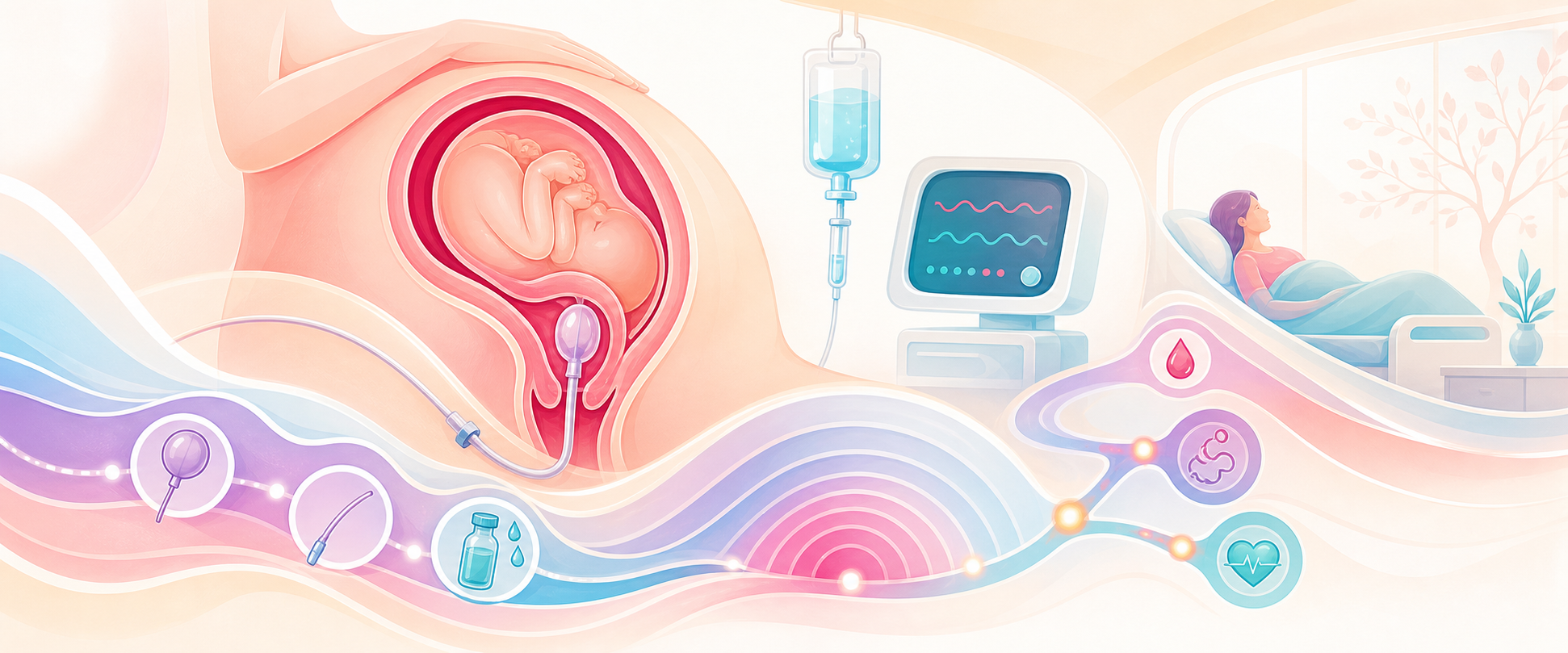
- A transcervical Foley or double-balloon ripens by direct stretch of the lower segment and cervix, which triggers endogenous prostaglandin and oxytocin release (a Ferguson-reflex-like local response) rather than delivering an exogenous uterotonic. The mechanistic consequence is decisive: because there is no exogenous uterotonic, the balloon essentially cannot cause pharmacological hyperstimulation, and the rupture risk in a scarred uterus approximates spontaneous labour. This is why it is the method of choice with a scar — not a guideline preference but a mechanistic one.
- The trade-off built into the mechanism: stretch ripens the cervix but does not establish contractions, so the balloon almost always needs sequential oxytocin afterward, and it is marginally slower to delivery than misoprostol.
3. Establishing/augmenting labour — oxytocin (the titratable subtype).
- IV oxytocin acts on myometrial oxytocin receptors whose density rises through gestation and labour; the clinical corollary is that the same infusion rate produces escalating effect as receptors upregulate, which is why oxytocin needs continuous titration and why a rate that was safe an hour ago can over-stimulate now. It has a short plasma half-life (~minutes), so stopping the infusion is itself the first tocolytic — a mechanism worth stating in the rescue sequence.
4. Membrane sweeping — the low-tech subtype.
- A finger sweep separates the chorion from the lower segment, releasing local prostaglandins and phospholipase A2. Mechanistically it promotes spontaneous labour rather than inducing it; it is an adjunct that defers formal IOL, not a method of it.
The unifying advanced point: the four subtypes sit on a spectrum from least controllable/most uterotonic (vaginal misoprostol depot) to most controllable/least uterotonic (balloon), and you choose where on that spectrum to sit by reading the scar, the fetal reserve and the resource setting. The scarred uterus and the compromised fetus push you toward the controllable end; affordability and storage push the SA system toward titrated oral misoprostol.
Management
Frame IOL as ripen → establish → augment → deliver, with continuous reassessment for the one complication that kills: hyperstimulation with fetal compromise.
Cervical ripening (Bishop ≤6). Three families of agents, contrasted:
| Method | Typical regimen | Strengths | Cautions |
|---|---|---|---|
| Oral misoprostol (PGE1) | SA practice: 200 µg tablet dissolved in 200 mL water → 25 µg (25 mL) orally 2-hourly, titrated to contractions | Cheap, heat-stable, no fridge, EML-listed, effective; titrated low-dose has the best overall utility profile | Hyperstimulation if dosed by ½/¼ tablets; never with a uterine scar |
| Vaginal dinoprostone (PGE2) | Tablet/gel or 10 mg controlled-release pessary | Removable pessary lets you stop the stimulus | Costly, cold-chain, limited at district level; same hyperstimulation risk |
| Mechanical (Foley/double balloon) | 30–60 mL balloon transcervical, ≤24 h | No pharmacological hyperstimulation; lowest fetal-distress signal; method of choice with a scar | Slightly slower; needs a passable os; small infection/bleeding signal |