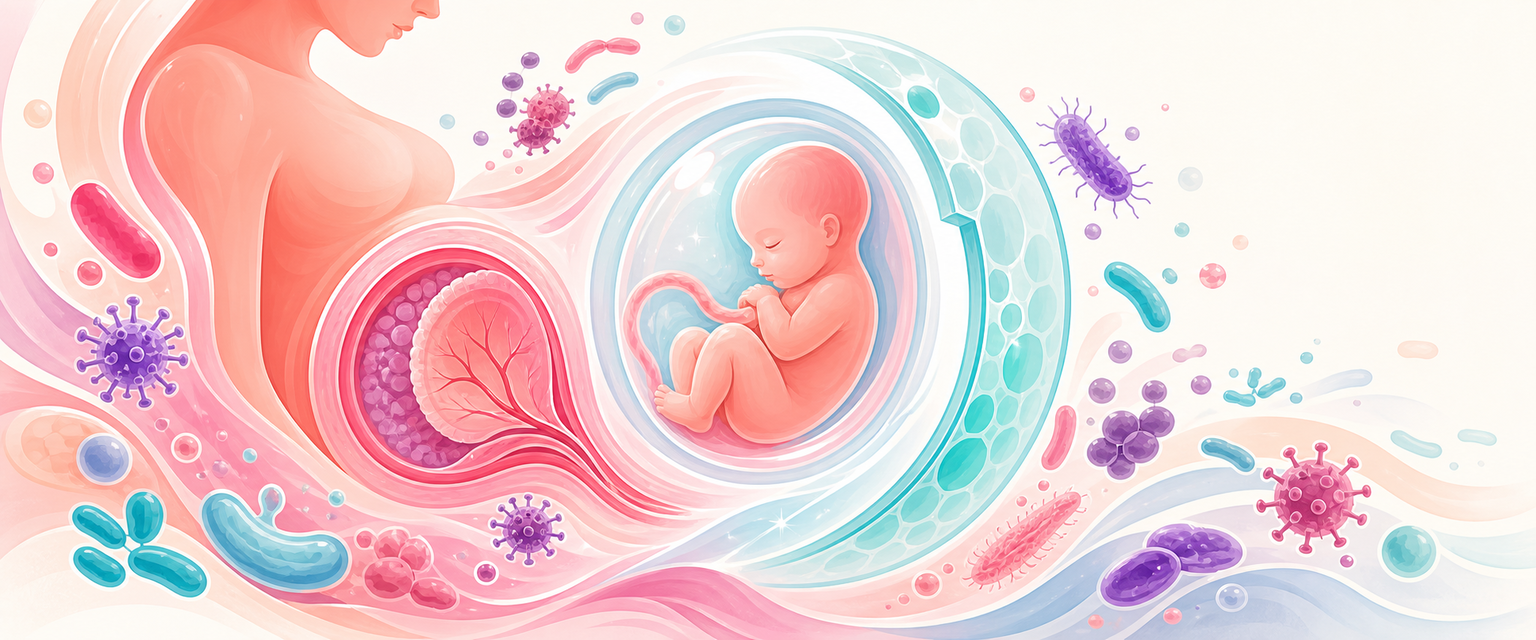
Micro-Organisms in Pregnancy and the Puerperium
Start with one idea and let everything hang off it: a microorganism causes harm only when it reaches a place it should not be, in numbers the host cannot control, and carries the tools to damage tissue or evade defence. Three variables — where, how many, armed with what — explain almost every infection in this chapter. Pregnancy and the puerperium change all three. They alter the barriers that keep organisms out, the immune thresholds that keep numbers down, the anatomy that decides where an organism lands, and the exposures the mother and baby meet. So the Primary task is not to memorise a TORCH list; it is to reason about host and pathogen together.
Where this microbiology is applied clinically is the Intermediate chapter on Intermediatetuberculosis and pneumonia in pregnancy, which covers the infections that dominate non-pregnancy-related maternal death in South Africa.
A second idea sits underneath the first: most organisms on and in the body are not pathogens at all. They are commensals — the normal microbiota — and they are often protective. Disease is usually a change in balance or location, not the simple arrival of a "germ". Holding both ideas at once (organisms are usually harmless; harm depends on site, load and weapons) is what separates a clinician who panics at every positive swab from one who interprets it.
The Primary question throughout is therefore: where is the organism, how did it reach that site, who is harmed — mother, fetus, neonate or all three — and how confident am I that this organism is actually causing the disease in front of me? The clinical management detail belongs in Intermediateinfections in pregnancy, Finalcongenital and perinatal infections and Finalmaternal sepsis. Here the focus is the host–pathogen logic.
Commensal or Pathogen: the First Distinction
Before naming any organism, fix the most basic distinction in clinical microbiology: isolating an organism is not the same as proving it caused disease. The body is not sterile. Skin, mouth, gut, upper airway and the lower genital tract all carry a dense resident microbiota, and many of those residents are also capable of causing disease elsewhere. Escherichia coli in the bowel is normal; E. coli in bladder urine is a urinary tract infection. The same species, a different site, a different meaning.
This gives a usable rule of thumb. An organism grown from a normally sterile site — blood, cerebrospinal fluid, amniotic fluid, deep pus, the inside of the uterus — is almost always significant. An organism grown from a site with its own rich microbiota — a high vaginal swab, a superficial wound — may simply be a coloniser, and the result has to be weighed against how the specimen was taken and how sick the patient is. Most species lead a double life: harmless resident in one host or site, dangerous invader in another. The shift to disease usually needs a breach (a wound, ruptured membranes, an instrumented uterus), an immunosuppressed or devitalised host, or selection pressure that lets one organism overgrow.
That last point is clinically sharp in obstetrics. Antibiotics create a selective medium inside the patient. Broad-spectrum cover removes the competing flora that normally keep a species in check, and whatever is left — often a resistant organism — overgrows. Wiping out the protective anaerobes of the gut, for example, allows Clostridioides difficile to proliferate and produce the toxins of pseudomembranous colitis. The protection that normal flora provide by simply occupying the niche and consuming resources is called colonisation resistance, and respecting it is part of stewardship. Holding the commensal-versus-pathogen idea firmly is what stops a colonised swab being treated as an emergency, and what stops a positive blood culture being dismissed as a contaminant.
The Normal Genital Tract: Why Oestrogen Makes It Acidic
Because so much obstetric infection starts in or passes through the lower genital tract, you must understand why a healthy vagina resists infection — and the mechanism is hormonal, which links this chapter directly to reproductive endocrinology.
Oestrogen drives the vaginal epithelium to lay down glycogen. Resident lactobacilli ferment the glucose released from that glycogen into lactic acid, holding the vaginal pH below about 4.5. That acidity, plus lactobacillus-produced hydrogen peroxide and bacteriocins, suppresses the overgrowth of other organisms. The vaginal community clusters into a small number of recurring profiles (community state types): several are dominated by a single Lactobacillus species and are low-diversity and stable; another is high-diversity, low in lactobacilli, and dominated by anaerobes such as Gardnerella, Prevotella and related genera. The low-diversity, lactobacillus-dominant states are generally the protective ones.
This explains two everyday observations. First, pregnancy increases physiological discharge and candidal colonisation because the high-oestrogen, glycogen-rich environment favours both lactobacilli and yeasts — most of this is normal and requires discrimination from infection, not treatment of a swab. Second, bacterial vaginosis is a shift, not a classic infection. The lactobacilli are displaced by a polymicrobial anaerobic community; the pH rises above 4.5; squamous cells become studded with adherent coccobacilli (clue cells); and a thin, fishy-smelling discharge appears. The word vaginosis (not vaginitis) is deliberate: there is little inflammation of the vaginal wall. This altered, less acidic, higher-diversity state is the one repeatedly associated with ascending infection, preterm labour and PPROM — the mechanism being loss of the acid barrier and a pro-inflammatory anaerobic load reaching the membranes. Loss of lactobacillus dominance, then, is not a cosmetic finding; it is a plausible upstream driver of preterm birth and of susceptibility to other genital infections.
Pregnancy Changes the Host-Pathogen Balance
With the resident-flora picture in place, layer pregnancy on top. Pregnancy is not immune paralysis. It is immune adaptation: tolerance at the maternal–fetal interface so the semi-allogeneic fetus is not rejected, while pathogen sensing is largely preserved. Alongside that immunological shift run mechanical and physiological changes. Together they alter how infection presents and how dangerous it becomes.
| Pregnancy factor | Microbiological implication | Clinical consequence |
|---|---|---|
| Decidual immune tolerance | Controls fetal rejection while still sensing pathogens | Infection can trigger inflammation at membranes and placenta |
| Increased oxygen demand and lower respiratory reserve | Respiratory infection is less well tolerated | Influenza, COVID-19 and pneumonia can deteriorate quickly |
| Urinary stasis and ureteric dilatation | Ascending urinary bacteria persist more easily | Asymptomatic bacteriuria and pyelonephritis matter |
| Oestrogenised genital tract | Discharge and Candida colonisation increase | Symptoms require discrimination from physiological discharge |
| Placenta as interface | Some organisms cross or infect placenta | Congenital infection, stillbirth, fetal growth restriction |
| Postpartum placental bed | Devitalised tissue and blood support bacterial growth | Endometritis and puerperal sepsis risk |
| Surgical/perineal wounds | Skin, enteric and genital organisms enter tissue | Caesarean, episiotomy and tear infections |
A practical corollary follows from the respiratory line: because the pregnant patient has less respiratory and cardiovascular reserve, an illness that a non-pregnant adult tolerates can decompensate quickly. The organism need not be unusually virulent; the host margin is simply thinner.
Placenta, Membranes and Maternal-Fetal Interface
The placenta is an immune interface, not a simple filter. Maternal blood bathes the chorionic villi, while fetal vessels stay separated from it by trophoblast, basement membranes and fetal endothelium. Organisms that harm a pregnancy do one of a few distinct things: they cross this interface, they infect and inflame it, they harm the mother so badly that uteroplacental function fails, or they bypass it entirely and reach the baby during or after birth.
| Interface event | Microbiology | O&G consequence |
|---|---|---|
| Direct placental infection | Organism replicates in placental tissue | Villitis, intervillositis, fetal growth restriction, fetal infection or loss |
| Ascending membrane inflammation | Lower tract organisms reach decidua, chorion and amnion | Chorioamnionitis, PPROM, preterm labour, fetal inflammatory response |
| Maternal systemic illness | Fever, hypoxia, anaemia or sepsis harms uteroplacental function | Preterm birth, fetal distress or stillbirth even without fetal infection |
| Intrapartum exposure | Neonate contacts blood, genital secretions or lesions | HSV, HIV if viraemic, HBV, gonorrhoea, chlamydia and GBS risk |
| Postnatal exposure | Breast milk, skin, respiratory droplets or household contacts | HIV during breastfeeding if viraemic, TB exposure, mastitis-associated organisms |
This is exactly why a single mnemonic list misleads. A feverish mother with listeriosis can have placental infection and neonatal sepsis. A mother with influenza may harm the fetus mainly through maternal hypoxia and preterm birth, with no fetal infection at all. A mother with herpes simplex lesions near delivery may have a purely neonatal-exposure problem even though the fetus developed normally in utero. Naming the interface event tells you what to look for and what to prevent.