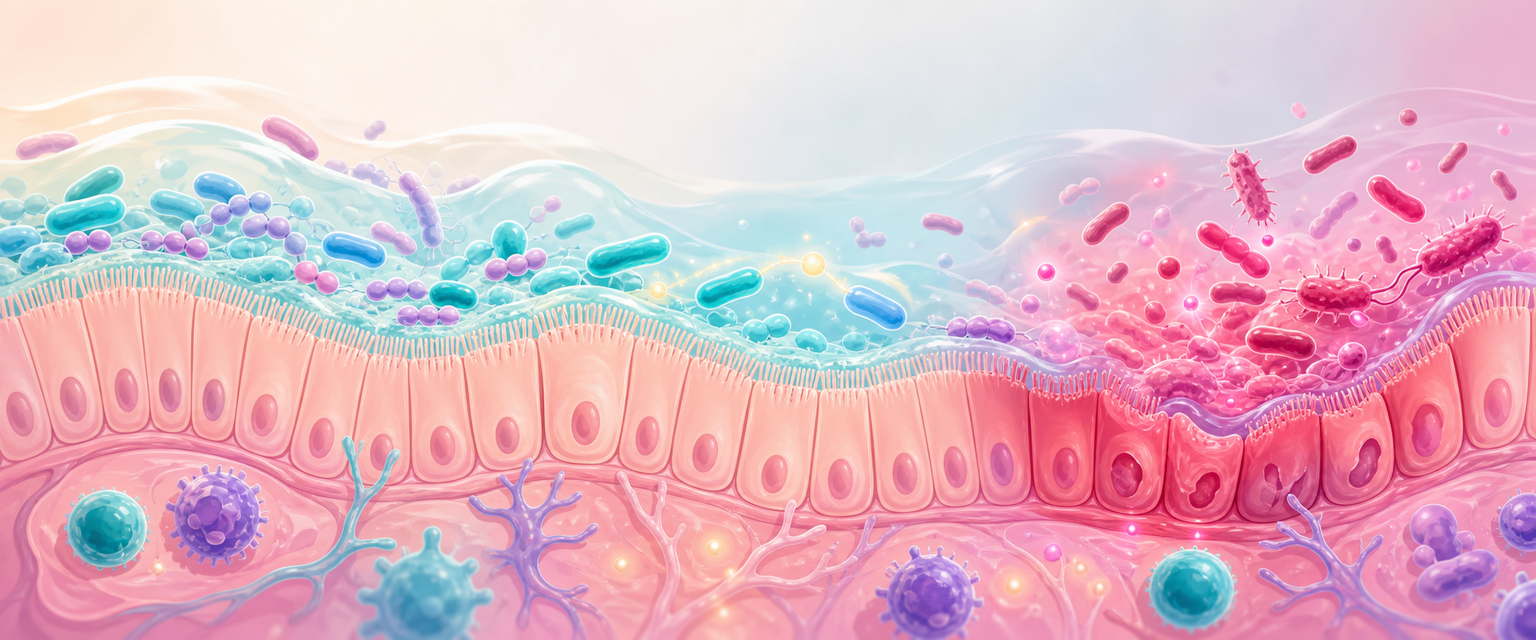
Human Microbiome
Start from one idea: you are never sterile, and that is normal. Every surface exposed to the outside world — skin, gut, mouth, vagina — is colonised by communities of microbes that arrived after birth and now live there permanently. These communities are not contaminants waiting to be eradicated. They are a working part of the body. The clinical art is telling apart the community that is protecting a surface from the same or similar organisms when they are injuring it.
From that single anchor everything in this chapter follows. If microbes normally live on us, then health is not the absence of organisms but the presence of the right community doing the right job. Disease is what happens when that community is lost, displaced, overgrown, inflamed, or carried into a place it does not belong. Treatment that ignores the community — that simply "kills bacteria" — can make the next problem worse.
Two definitions make this precise. The microbiota are the organisms living on and in the body. The microbiome includes those organisms plus their genes, metabolites and functional potential — what the community can do, not just who is present. The distinction matters because two people can carry similar organisms but very different functions, and because modern tests increasingly measure genes and metabolites rather than just names.
In O&G the important sites are the vagina, gut, skin, urinary tract, the placenta and membrane interface in disease, and the maternal-neonatal transition around birth. We will build from general microbial ecology, to the vagina as the keystone O&G example, to how this reasoning is used and mis-used at the bedside.
The microbiome is clinically useful because it explains:
- Colonisation resistance: resident organisms make invasion harder.
- Mucosal immune calibration: the host learns tolerance and response thresholds.
- Metabolite production: local pH, short-chain fatty acids and other metabolites shape tissue function.
- Antibiotic collateral damage: treatment changes ecosystems, not only pathogens.
- Maternal-neonatal transfer: birth, skin contact, feeding and antibiotics influence early microbial exposure.
The exam-safe tone is balanced. Microbiome patterns matter, but detecting microbial DNA does not always prove live infection, causation or a need for treatment.
At this level, focus on ecology, host response and interpretation limits. The linked higher-course chapters apply these ideas to discharge, PID, pregnancy infection and congenital infection management.
Think of the microbiome as an organ-like ecosystem: it has membership, functions, metabolites, resilience and failure modes. A name list alone is shallow. The clinically useful questions are whether the community protects the mucosa, produces harmful metabolites, permits invasion, stimulates inflammation or reflects a disturbed host environment.
Microbial Ecology at the Bedside
Microbiome reasoning starts with a niche. A niche is not just a body site; it is the local pH, oxygen tension, nutrient supply, epithelium, mucus, immune tone, hormones, competing organisms and exposures.
| Ecological idea | Meaning | O&G example |
|---|---|---|
| Niche | Local environment that selects organisms | Oestrogenised vaginal epithelium favours lactobacilli |
| Colonisation resistance | Resident community blocks invaders | Low pH and lactate reduce overgrowth of many anaerobes |
| Functional redundancy | Different organisms perform similar functions | Gut diversity can preserve short-chain fatty acid production |
| Keystone organism/function | One organism or function strongly shapes the site | Lactobacillus dominance shapes vaginal pH |
| Perturbation | Disturbance to the ecosystem | Antibiotics, semen, menstruation, douching, rupture of membranes |
| Resilience | Return toward baseline after disturbance | Failure of resilience contributes to recurrent BV or candidiasis |
| Pathobiont | Usually tolerated organism that can cause disease in the wrong context | Group B streptococcus, E. coli, anaerobes after tissue damage |
Mechanism chain:
hormones and host tissue -> available nutrients and pH -> microbial membership -> metabolites and immune signalling -> barrier strength or inflammation -> clinical phenotype.
This chain keeps the answer away from the weak phrase "abnormal flora" and toward a defensible mechanism.
Why communities, not single organisms
A microbial community is not a random crowd; the members shape the niche for one another. The clearest example is oxygen. Aerobic organisms consume oxygen, which lowers the local oxygen tension and lets strict anaerobes proliferate behind them. This is why anaerobes vastly outnumber aerobes at colonised surfaces — by roughly tenfold to a hundredfold on skin, and by more than a thousandfold in the large bowel. The community engineers its own low-oxygen interior. Disturb the aerobes and you disturb the anaerobes that depend on them.
Resident communities also feed and defend the host directly. Gut organisms synthesise vitamins and ferment dietary fibre into short-chain fatty acids; skin organisms release fatty acids and other inhibitory substances that keep transient invaders from settling. Constant low-level stimulation of the immune system by harmless residents trains the host to recognise — and to tolerate — what belongs, so that genuinely pathogenic newcomers are met more quickly. The community is therefore nutritional, immunological and protective all at once, which is exactly why "the microbiome" behaves like an organ rather than a passenger list.
Colonisation resistance, made concrete
The single most useful ecological idea for an O&G clinician is colonisation resistance: a healthy resident community physically and chemically blocks newcomers from establishing. The canonical demonstration is the gut. Clostridioides difficile is carried silently in a small minority of healthy people, held in check by the surrounding anaerobic community. Broad-spectrum antibiotics strip out that community; with the competitors gone, C. difficile expands and its toxins produce pseudomembranous colitis. The decisive evidence that the community — not the drug itself — was protective is that re-introducing a healthy community by faecal microbiota transplantation cures the infection where further antibiotics fail. Restore the function and the pathogen can no longer thrive.
Hold this example in mind for the rest of the chapter, because the vagina works the same way: lose the resident lactobacilli and an anaerobe-rich community takes their place. The site changes but the logic does not.
Vocabulary
| Term | Meaning | Exam trap |
|---|---|---|
| Microbiota | Organisms present in a site | Culture and sequencing detect different parts of this |
| Microbiome | Organisms plus genes/functions/metabolites | Not just a list of names |
| Alpha diversity | Diversity within one sample | High diversity is not always healthy in vagina |
| Beta diversity | Difference between communities | Useful for research/population comparison |
| Dysbiosis | Community disturbance associated with disease | Association is not automatically causation |
| Community state type | Recurrent vaginal community pattern | Categories simplify a continuum |
| Metagenomics | Sequencing microbial genetic material | DNA can persist after organisms die |
| Metabolomics | Study of microbial/host metabolites | Function may matter more than taxonomy |
How Microbiomes Are Studied
Different methods answer different questions. This matters because bedside interpretation often borrows language from research without respecting its limits.
| Method | What it detects | Strength | Limitation |
|---|---|---|---|
| Culture | Viable organisms that grow under chosen conditions | Allows susceptibility testing for many bacteria | Misses unculturable or fastidious organisms |
| Microscopy/Gram stain | Morphology, inflammation and community pattern | Fast; useful in BV/candidiasis reasoning | Limited species-level detail |
| NAAT/PCR panel | Specific nucleic acid targets | Sensitive for selected pathogens | May detect non-viable organisms or colonisation |
| 16S rRNA sequencing | Bacterial community composition | Broad bacterial survey | Limited species resolution; contamination risk |
| Metagenomic sequencing | Wider genetic content and potential function | Research-rich; can detect unexpected organisms | Expensive, complex, not automatically causal |
| Metatranscriptomics/metabolomics | Active genes/metabolites | Closer to function | Harder to standardise clinically |