Clinical overview
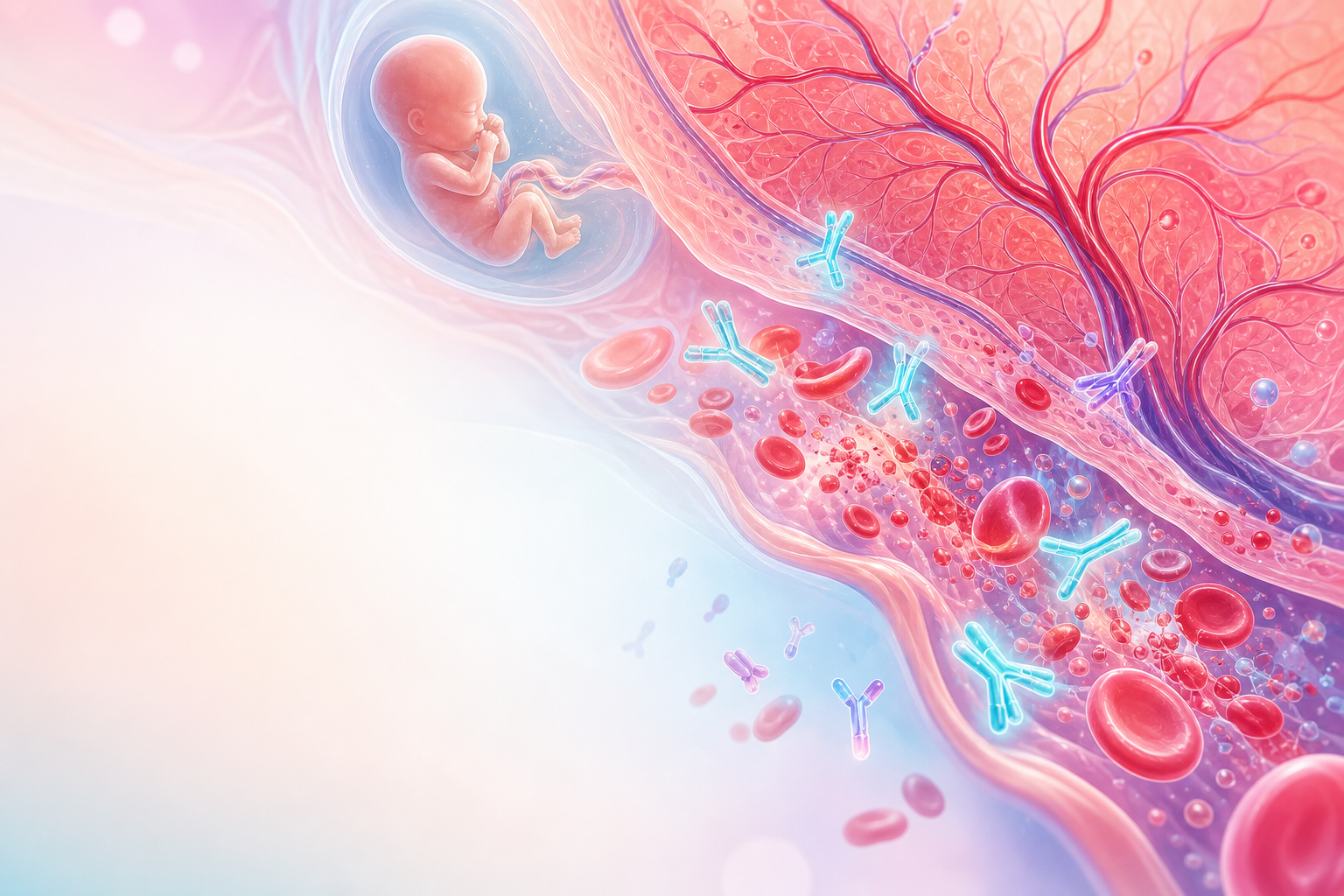
Rhesus (Rh) isoimmunisation — more precisely, red-cell alloimmunisation — is the process whereby a pregnant woman who lacks a particular red-cell antigen is exposed to fetal red cells carrying that antigen, mounts an immune response, and produces IgG antibodies that cross the placenta and destroy fetal and neonatal red cells. The clinical consequence is haemolytic disease of the fetus and newborn (HDFN): progressive fetal anaemia, hydrops fetalis, intrauterine death, and severe neonatal jaundice with the risk of kernicterus. The dominant culprit historically is the RhD antigen, hence "Rh isoimmunisation", but the same disease can be caused by anti-c, anti-Kell (anti-K), anti-E and many other antibodies — and Kell sensitisation can be more dangerous than D because it also suppresses erythropoiesis.
This is one of obstetrics' great prevention success stories. Routine anti-D immunoglobulin prophylaxis has reduced RhD sensitisation in developed health systems from a major cause of perinatal loss to a rare event. In South Africa, however, prevention is uneven: anti-D supply, the timing of cover for potentially sensitising events, and access to specialist fetal-medicine monitoring all vary by level of care. The registrar must therefore understand both the immunology (to prevent sensitisation reliably) and the fetal-medicine pathway (to rescue the already-sensitised pregnancy). HDFN sits alongside antepartum-haemorrhage and hypertension-in-pregnancy as a complicated-obstetrics problem where booking bloods, vigilance for sensitising events, and timely referral change outcomes. Anti-D prophylaxis and red-cell antibody management are anchored in the SA National Integrated Maternal and Perinatal Care Guideline (NDoH, 2024), with international detail from NICE TA156, BSH red-cell-antibody guidance and ISUOG Doppler standards.
Core knowledge
The Rh blood group system
The Rh system is coded by two adjacent genes on chromosome 1: RHD (encoding the D antigen) and RHCE (encoding C/c and E/e antigens). "Rh-positive" means the D antigen is present; "Rh-negative" means it is absent — most commonly because the entire RHD gene is deleted. RhD negativity is a recessive phenotype. Antigen prevalence is strongly population-dependent: roughly 15% of people of European ancestry are RhD-negative, but the proportion is considerably lower in most African and Asian populations. In the South African setting the mix of ancestries means RhD-negative women are a clinically important minority in every booking clinic, so every booking visit must include blood group and antibody screening (standard SA antenatal practice; SA Maternity Guideline (NDoH, 2024)).
How sensitisation happens
A woman becomes alloimmunised when fetal red cells carrying an antigen she lacks enter her circulation in sufficient quantity and provoke antibody formation. The largest fetomaternal haemorrhage (FMH) typically occurs at delivery, but sensitising events occur throughout pregnancy: miscarriage, ectopic pregnancy, termination-of-pregnancy, antepartum haemorrhage, abdominal trauma, external cephalic version, invasive procedures (amniocentesis, chorionic villus sampling), and intrauterine death. Even a small volume of fetal blood — classically of the order of well under a millilitre — can sensitise.
The first exposure usually generates a primary IgM response that does not cross the placenta, so a first sensitising pregnancy is often spared. The danger is the anamnestic (secondary) response in a subsequent pregnancy: rapid, high-titre IgG production. IgG crosses the placenta actively, coats antigen-positive fetal red cells, and triggers their destruction in the fetal reticuloendothelial system (predominantly the spleen).
From antibody to hydrops
Fetal haemolysis drives compensatory extramedullary haematopoiesis in the liver and spleen, causing hepatosplenomegaly. As anaemia worsens, hepatic architecture is disrupted, portal hypertension and hypoalbuminaemia develop, and high-output cardiac failure ensues. The end stage is hydrops fetalis — abnormal fluid in two or more compartments (ascites, pleural and pericardial effusions, skin oedema, polyhydramnios, placental oedema) — which carries a high risk of intrauterine death.
After birth the placental "clearance" of bilirubin is lost, so the neonate develops rapid, severe unconjugated hyperbilirubinaemia. Unconjugated bilirubin crosses the immature blood–brain barrier and deposits in the basal ganglia, producing acute bilirubin encephalopathy and, if untreated, kernicterus — choreoathetoid cerebral palsy, sensorineural hearing loss and gaze palsy.
Figure J16.1 — Mechanism of Rh alloimmunisation from fetomaternal haemorrhage and IgG-mediated fetal haemolysis through hydrops and neonatal bilirubin risk.
Antibodies that matter
Not all red-cell antibodies cause HDFN, and they differ in severity:
| Antibody | HDFN risk | Notes |
|---|---|---|
| Anti-D | High | Classic, fully preventable with anti-D Ig |
| Anti-c | High | Can cause severe disease; not prevented by anti-D |
| Anti-K (Kell) | High, can be severe | Suppresses fetal erythropoiesis as well as causing haemolysis; titre correlates poorly with severity |
| Anti-E | Moderate | Often milder |
| Anti-Lewis, anti-P1, anti-M (usually IgM) | None / negligible | IgM does not cross placenta |
A key teaching point: anti-D prophylaxis prevents only anti-D sensitisation. It does nothing for anti-Kell, anti-c or other antibodies, which is why the booking antibody screen matters for every woman regardless of D status.
Assessment
Booking and screening
At booking, determine ABO and RhD group and perform an antibody screen (indirect Coombs / indirect antiglobulin test) on every woman (SA Maternity Guideline (NDoH, 2024)). The pathway then forks:
- RhD-negative, antibody-negative: offer routine anti-D prophylaxis (see Management) and repeat antibody screening later in pregnancy to detect new sensitisation. Knowing the partner's RhD status helps — if the biological father is confidently RhD-negative, the fetus cannot be RhD-positive and prophylaxis is unnecessary, though paternity uncertainty means most programmes proceed with prophylaxis.
- Antibody-positive (any clinically significant antibody): identify and quantify the antibody, and shift to a surveillance pathway for fetal anaemia.
Quantifying and monitoring antibodies
Once a clinically significant antibody is identified, the laboratory identifies the specificity and quantifies the level — anti-D and anti-c are reported by quantitation (in IU/mL) where available, while many other antibodies (and Kell) are followed by titre (BSH red-cell-antibody guidance). Rising or high levels trigger referral. Standard teaching is that anti-Kell should prompt referral at low titres because titre correlates poorly with disease severity. Levels are typically rechecked at intervals (e.g. monthly, then more frequently in the third trimester) — the exact thresholds for referral are laboratory- and guideline-specific, so check the current local protocol rather than memorise a single cut-off.
Detecting fetal anaemia
The pivotal advance is non-invasive detection of fetal anaemia with Doppler measurement of the middle cerebral artery peak systolic velocity (MCA-PSV). Anaemia lowers blood viscosity and raises cardiac output, so peak systolic velocity rises. An MCA-PSV above 1.5 multiples of the median (MoM) for gestation is the recognised threshold predicting moderate-to-severe fetal anaemia and prompts consideration of invasive testing or transfusion (ISUOG Doppler standards; this is the Mari MCA-PSV approach used internationally). Serial MCA-PSV has largely replaced serial amniocentesis (the older Liley/Queenan amniotic-fluid bilirubin "ΔOD₄₅₀" charts) for monitoring, sparing the fetus repeated invasive procedures.
Ultrasound also assesses for early hydrops — ascites, effusions, skin oedema, hepatomegaly, polyhydramnios and placentomegaly — although these are late signs; the aim of MCA-PSV surveillance is to intervene before hydrops develops.
Fetal RhD genotyping and Kleihauer
Two further tests inform management:
- Cell-free fetal DNA (cffDNA) RhD genotyping on maternal plasma can determine fetal RhD status non-invasively from the first trimester onward. Where available, this allows prophylaxis (or surveillance) to be targeted only at women carrying RhD-positive fetuses. Availability in SA public services is limited, so universal prophylaxis for RhD-negative women remains standard here.
- The Kleihauer–Betke test (acid-elution) quantifies the volume of fetal red cells in the maternal circulation after a potentially sensitising event. It is used to detect a large FMH and to calculate whether additional anti-D beyond the standard dose is required. Flow cytometry is an alternative quantitation method where available.
Management
Management has two distinct arms: prevent sensitisation in the RhD-negative, antibody-negative woman, and rescue the fetus of the already-sensitised woman.
Prevention — anti-D immunoglobulin
Anti-D immunoglobulin works by passive-immune clearance: administered anti-D binds circulating RhD-positive fetal cells and removes them before the maternal immune system can mount its own response, blunting active sensitisation. It must be given to RhD-negative, non-sensitised women (it is useless and unnecessary once a woman has already formed her own anti-D).
Anti-D is indicated for:
- Routine antenatal prophylaxis in RhD-negative, antibody-negative women. Internationally this is given as a single or two-dose third-trimester regimen (routine antenatal anti-D prophylaxis, RAADP; NICE TA156). The SA programme prioritises postpartum and event-driven cover where supply is constrained — follow the SA Maternity Guideline (NDoH, 2024) and local protocol for the antenatal-prophylaxis schedule and exact dosing, as dose and timing vary between programmes.
- After any potentially sensitising event — miscarriage (especially if surgical or after the early-pregnancy threshold), termination-of-pregnancy, ectopic pregnancy, antepartum haemorrhage, abdominal trauma, external cephalic version, amniocentesis/CVS, and intrauterine death. Anti-D should be given as soon as possible and within 72 hours of the event; if missed, it may still offer some protection if given later, so do not withhold it because the 72-hour window has passed.
- After delivery of an RhD-positive baby. Determine the baby's RhD group from cord blood; if RhD-positive, give anti-D to the mother within 72 hours. A Kleihauer at delivery detects a large FMH that requires additional anti-D beyond the standard dose.
The cardinal rule: confirm the woman is RhD-negative and antibody-negative before giving anti-D, and document every dose. Never give anti-D to an already-sensitised woman expecting it to help — it will not.

Figure J16.2 — Anti-D prevention map showing the booking-screen fork, routine prophylaxis, sensitising-event cover, delivery Kleihauer logic and the high-yield rule that anti-D prevents anti-D only.
Rescue — managing the sensitised pregnancy
A pregnancy with a clinically significant antibody and a potentially antigen-positive fetus must be referred to a fetal-medicine / tertiary unit (regional or tertiary level of care in the SA system). The pathway is:
- Identify and quantify the antibody; establish (or assume) fetal antigen positivity.
- Serial MCA-PSV surveillance for fetal anaemia, typically from around the mid-second trimester, at intervals set by the unit.
- When MCA-PSV exceeds 1.5 MoM or hydrops appears, proceed to fetal blood sampling to confirm anaemia and, in the same procedure, intrauterine transfusion (IUT) of antigen-negative, irradiated, packed red cells into the umbilical vein. IUT is a specialist fetal-medicine procedure that may need to be repeated until delivery is appropriate.
- Time delivery to balance the risks of prematurity against ongoing haemolysis — generally aiming to reach a gestation where neonatal management is safe, often delivering in the late preterm to early term range depending on disease severity and transfusion history. Plan delivery at a facility with neonatal intensive-care and exchange-transfusion capacity.
Neonatal management
The neonate of a sensitised pregnancy needs paediatric/neonatal handover before delivery. Cord blood is sent for group, direct antiglobulin test (DAT/direct Coombs), haemoglobin and bilirubin. Management of HDFN in the newborn includes intensive phototherapy, and for severe hyperbilirubinaemia or anaemia, exchange transfusion to remove antibody-coated cells and bilirubin. Intravenous immunoglobulin is used in some protocols. Late anaemia can develop over the following weeks and warrants follow-up.

Figure J16.3 — Sensitised-pregnancy rescue pathway using antibody quantification, fetal-risk assessment, MCA-PSV surveillance, urgent IUT triggers, delivery planning and neonatal HDFN handover.
Emergency recognition
Hydrops / severe fetal anaemia is a fetal-medicine emergency. An RhD-negative or antibody-positive woman presenting with reduced fetal movements, an ultrasound showing ascites, effusions or skin oedema, or an MCA-PSV >1.5 MoM, must be discussed with the fetal-medicine / tertiary unit the same day for urgent transfer. Do not arrange routine outpatient follow-up. See decreased-fetal-movements.
Potentially sensitising event drill: for any bleeding, trauma, procedure or pregnancy loss in an RhD-negative woman — (1) confirm RhD-negative and antibody status, (2) take a Kleihauer sample, (3) give anti-D within 72 hours (sooner is better), (4) document the dose and the event. When in doubt about whether an event qualifies, give anti-D — the risk of withholding far outweighs the risk of giving it.
Red flags / pitfalls
- Forgetting anti-D after "minor" events. Threatened miscarriage, a small antepartum bleed, ECV or abdominal trauma in an RhD-negative woman all warrant assessment for anti-D. Omitting it is a classic, preventable cause of sensitisation in the next pregnancy.
- Missing the 72-hour window — but then withholding anyway. Anti-D works best within 72 hours, but late administration may still help; give it even if you are past the window.
- Giving anti-D to an already-sensitised woman. Once active anti-D is present, prophylaxis is futile. Confirm she is antibody-negative first. Conversely, a positive antibody screen that is actually passive anti-D from a recent prophylactic dose can be mistaken for sensitisation — interpret the antibody screen in the light of recent anti-D administration.
- Assuming anti-D prophylaxis covers all HDFN. It prevents only anti-D sensitisation. Anti-Kell, anti-c and others are not prevented and demand their own surveillance — which is why every woman, RhD-positive or negative, needs a booking antibody screen.
- Underestimating anti-Kell. Kell suppresses erythropoiesis, so the fetus can be severely anaemic with relatively low maternal titres and a relatively low reticulocyte response; refer early and rely on MCA-PSV rather than titre alone.
- Relying on hydrops as the trigger to act. Hydrops is a late sign. The whole point of MCA-PSV surveillance is to detect and treat anaemia before decompensation.
- Not quantifying a large FMH. After a major sensitising event (e.g. abruption, trauma, IUFD), a single standard anti-D dose may be insufficient; a Kleihauer guides whether additional anti-D is needed.
- Failing to check the partner / fetal status where available. Where cffDNA RhD genotyping or a confidently RhD-negative partner is established, unnecessary prophylaxis can be avoided — but never withhold prophylaxis on uncertain paternity.
- Cord-blood logistics at delivery. Always group the baby and run a Kleihauer on the mother at delivery; a system that does not reliably do this will miss the most important sensitising event of all.
Evidence anchors
- SA National Integrated Maternal and Perinatal Care Guideline (NDoH, 2024) — the South African source of truth for booking blood group and antibody screening, anti-D prophylaxis indications and the schedule/dosing used in SA, and referral of sensitised pregnancies.
- NICE TA156 — Routine antenatal anti-D prophylaxis for RhD-negative women (with current BSH/NHS practice) — the verified substitute for the archived RCOG GTG 22; basis for routine antenatal anti-D prophylaxis (RAADP).
- BSH (British Society for Haematology) guidance on red cell antibodies in pregnancy — the verified substitute for the archived RCOG GTG 65; identification, quantitation/titre and monitoring of clinically significant antibodies including anti-D, anti-c and anti-Kell.
- ISUOG Doppler standards — middle cerebral artery peak systolic velocity (MCA-PSV) measurement for non-invasive detection of fetal anaemia; the >1.5 MoM threshold (Mari approach) for moderate-to-severe anaemia.
- Saving Mothers / NCCEMD (latest triennium) — South African maternal-mortality context within which alloimmunisation services and tertiary referral operate.
(Standard textbook facts stated cautiously where not line-itemed in the verified sources: the Liley/Queenan amniotic-fluid bilirubin charts as the historical monitoring method; the broad RhD-negative prevalence figures; the Kleihauer–Betke acid-elution principle; the 72-hour anti-D window; and the neonatal phototherapy/exchange-transfusion thresholds — exact doses and cut-offs should be taken from the current SA Maternity Guideline and local laboratory/neonatal protocols.)
